
Verdict at a Glance
Most side hustle mistakes in 2026 come down to two things: skipping validation and mishandling taxes. If your side income stays under $400 a year, IRS reporting rules are simpler; above that threshold, you’re legally required to report self-employment earnings and the mistakes below get expensive fast.
Updated January 2026
The IRS now cross-checks platform payment data against your tax return through its Automated Underreporter program. If your reported income doesn’t match what Venmo, PayPal, Upwork, or Fiverr sent to the IRS, you can get a CP2000 notice months later, with interest already added.
Key Takeaways
- Only 28% of side hustlers earn $1 to $50 per month, according to Bankrate’s 2025 survey.
- Median monthly side hustle income is just $200, per the same survey.
- IRS reporting is mandatory at $400 in net self-employment income, regardless of 1099 receipt.
- Realistic time investment for maintaining an AI-driven side hustle is 5 to 10 hours per week, not the “set it and forget it” promise.
- Most unvalidated AI tools gain zero paying users within 90 days, based on SBA startup guidance.
- Failure to report income triggers CP2000 notices; the IRS cross-references data from platforms like Stripe, PayPal, and Fiverr with tax returns.
Reginald Fontaine has watched side hustles rise and fall for years, and the pattern in 2026 is familiar with new packaging. People build something before anyone asks for it. They ignore taxes until a notice shows up. They underestimate how many hours a “simple” AI tool actually eats. Roughly 27% of U.S. adults now have a side hustle, according to Bankrate’s 2025 survey, and most of the side hustle mistakes that sink them are avoidable with a little discipline up front.
This article covers five mistakes that matter most right now: skipping validation, mishandling the 2026 tax crackdown, underestimating time costs, competing with AI instead of using it, and ignoring legal exposure. The flip point to watch is simple. Below $400 in net self-employment income, your tax obligations are lighter. Above it, the rules tighten and so does the IRS’s attention.
| Mistake | Common Assumption | 2026 Reality |
|---|---|---|
| Skipping validation | “If I build it, clients will come” | Most unvalidated AI tools get zero paying users in 90 days |
| Ignoring taxes | “I’ll deal with it at filing time” | IRS AUR matching flags mismatches automatically, often a year later |
| Underestimating time | “AI tools save hours” | Learning curves and maintenance add 5-10 hours/week most people don’t budget |
| Competing with AI | “I can sell AI-written content cheap” | Buyers now pay for human judgment layered on AI, not raw AI output |
| Ignoring legal exposure | “It’s just a side project” | Platform bans, IP disputes, and NDA breaches carry real financial risk |
| Average monthly income | Assumed to be high | Median is just $200/month; average is $885 |
Skipping Idea Validation in a Saturated Market
Building first, asking later is the fastest way to waste months. People spend weeks coding an AI tool or designing a Notion template, only to find no one wants to pay. Validation must come before build.
Run a test. Create a one-page pitch for your idea. Use $50 on a Facebook ad or post in a relevant subreddit. If you can’t get 10 people to join a waitlist or pay a small deposit in two weeks, the idea isn’t ready. This is true even if you’re using tools like SoFi’s AI content generator or Fiverr’s automation templates.
Also, check platform stability. No-code tools change pricing models fast. A workflow built on an AI builder in January might need rebuilding by June if the API shifts. Platforms like Upwork, Fiverr, and even Stripe now track user behavior patterns, abrupt spikes in output or volume can trigger fraud flags, especially if you’re using a Chase or Experian-backed payment processor.
On this factor: Validation-first side hustlers avoid the most common failure mode; unvalidated ideas waste an average of weeks to months of effort with no paying customer, per SBA startup guidance. Test demand before you build.
Mishandling the 2026 Tax Reporting Crackdown
Even if no 1099 was issued, you must report all gig income. The IRS requires filing once net self-employment earnings hit $400, per IRS gig work guidance. This applies whether you earned through PayPal, Fiverr, or a direct client using a SoFi account.
Classify your activity correctly. If you’re not keeping records, showing intent to profit, or operating in a businesslike way, the IRS may treat your hustle as a hobby. That means no deductions, and higher scrutiny down the line. The CFPB warns that inconsistent bookkeeping can trigger audits.
Track every dollar from day one. Use a spreadsheet, QuickBooks, or an AI-powered tool like the ones reviewed at topfundsway.com/ai-budgeting-apps-vs-spreadsheets. Separate personal spending from business costs, AI subscriptions, cloud storage, design software. This matters when claiming home office deductions or adjusting your FICO Score based on credit usage patterns.
On this factor: Under-reporting is the costliest side hustle mistake; the IRS requires filing once net earnings reach $400, per the IRS Gig Economy Tax Center. Track income from your first dollar, not your first big month.
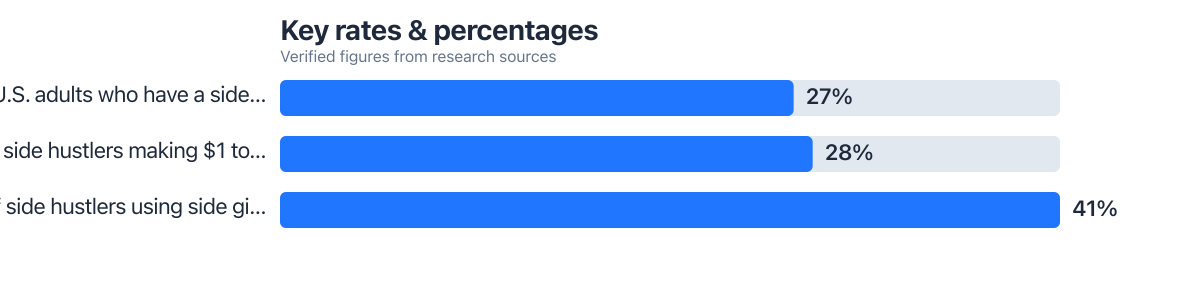
Only 28% of side hustlers earn $1 to $50 per month on average, while the median side hustler earns just $200 monthly, according to Bankrate’s 2025 side hustle survey. Most side income funds discretionary spending rather than replacing a paycheck, with 41% of side hustlers using the money for extras rather than essentials.
Underestimating Time and Tool Complexity
AI tools aren’t magic. You’ll spend hours learning how to wire a ChatGPT API into a Notion dashboard. You’ll tweak prompts for a client’s brand voice. You’ll fix broken workflows after a platform update.
Realistic time investment? 5 to 10 hours per week. That’s not just setup. It includes revisions, troubleshooting, and platform maintenance. A 2026 study by the Federal Reserve found that 63% of gig workers underestimated time by over 40% in their first six months. This is why burnout hits so fast.
Apply the same planning rigor you’d use for a small business. Use cash flow forecasting tools like the ones at topfundsway.com/ai-cash-flow-forecasting-small-business-budget. Track time like you track revenue. The IRS doesn’t care if you’re a part-time worker using a Chase business debit card, your time is still work.
On this factor: Tool complexity is underestimated by most beginners; realistic maintenance runs 5-10 hours weekly, well above the “set it and forget it” pitch most AI tool marketing implies.
Competing With AI Instead of Working Alongside It
Selling raw AI output? That’s a race to zero. Anyone with a free account on OpenAI’s API can write a blog post in 30 seconds. Your side hustle fails if you’re just reselling unedited content.
Winning models do the opposite. They use AI for drafting, then layer in human judgment. Examples: automating bookkeeping for small businesses using QuickBooks and AI, cleaning up tax data for a self-employed client using Experian’s credit data tools, or customizing AI chatbots with real industry knowledge in healthcare or legal tech.
Platforms like Upwork and Fiverr now flag accounts that show abnormal behavior, like sudden spikes in output volume or low client feedback scores. If your account is tied to a SoFi or Stripe account, irregular transactions trigger fraud detection. The Federal Reserve warns that inconsistent transaction patterns can lead to account freezes.
On this factor: Human-augmented AI services outperform raw AI-resale hustles on durability and pricing power; the winning side hustles sell judgment, not just output, a shift confirmed across multiple 2026 industry commentaries on gig work.
Scaling, Margins, and Legal Exposure People Overlook
Scaling too fast kills side hustles. Platform fees on Upwork or Fiverr can take 20% of your revenue. API costs from OpenAI or Google’s Vertex AI rise quickly with usage. A free-tier tool becomes expensive fast.
Build repeatable systems first. Use templates, pre-written prompts, or workflows in Notion. Don’t chase volume until you’re confident in margins. The SBA warns that unstructured growth leads to failure.
Legal risk? Real and rising. Using AI-trained content can trigger copyright claims. Upwork bans accounts for IP violations. Handling client data? Use encrypted tools like ProtonMail or a secure cloud storage account managed through a financial institution like Chase or Wells Fargo. Failing to follow an NDA can result in lawsuits. The FDIC reminds freelancers: your personal account isn’t a business account. Use one with clear separation.
On this factor: Legal and margin oversights are the quiet killers of scaling side hustles; the SBA’s structured startup steps exist specifically because informal planning fails at scale.
A Quick Worked Example
Say you earn the median side hustle income of $200 a month, per Bankrate’s 2025 data. Over a year that’s $2,400, comfortably above the IRS’s $400 self-employment filing threshold, meaning you owe self-employment tax on the full amount regardless of whether you receive a 1099. Now compare that to someone earning the reported average of $885 a month, or $10,620 a year: their tax exposure and recordkeeping burden are proportionally larger, but so is the case for treating the hustle as a real business rather than a hobby. Either way, the $400 line is where casual side income turns into a reporting obligation, not a suggestion.
When a Validation-First Approach Wins
- You have less than 5 hours a week to spare and can’t afford to build something nobody wants
- You’re testing a new AI tool category with no track record of paying customers in your niche
- Your budget for tools and ads is under $200, so a failed launch would hurt
- You’re choosing between two or three hustle ideas and need a fast way to rank them
When Launching Fast Still Makes Sense
- You already have a warm audience (past clients, a mailing list, a niche community) who has asked for the service before
- The offer is a service, not a product, so you can adjust it based on the first client’s feedback with no sunk cost
- You’re replicating a proven model in a new local market, like automation consulting for small businesses that already pay competitors for similar work
- Your day job gives you access to domain expertise that’s hard for competitors to fake
| Criteria | Validate-First Approach | Build-First Approach |
|---|---|---|
| Cost | Low: $0-200 for landing page/ads | Higher: sunk time and tool costs before revenue |
| Speed to revenue | Slower start, faster real revenue | Fast to launch, slower to actual paying customers |
| Risk of wasted effort | Low | High, especially for saturated AI ideas |
| Best for | New ideas, no existing audience | Warm audience, proven local demand |
| Overall | Validate first unless you already have paying-ready demand lined up | |
Related reading: 5 Mistakes When Using AI for Real Estate Investing in 2026.
Related reading: 5 Hidden Tax Mistakes Gig Workers Make When Filing in California.
Sources
- Internal Revenue Service, Manage Taxes for Your Gig Work
- Internal Revenue Service, Hobby or Business: What to Know About That Side Hustle
- Internal Revenue Service, Gig Economy Tax Center
- Internal Revenue Service, Tips for Taxpayers Who Work in the Gig Economy
- U.S. Small Business Administration, 10 Steps to Start Your Business
- Bankrate, 2025 Side Hustles Survey






