
Verdict at a Glance
DIY tracking wins for side hustlers earning under roughly $20,000 a year with straightforward income, because spreadsheets and free apps cover the basics without added cost. Choose hiring a tax pro or accounting software with human backup instead once net profit clears $20,000, you juggle multiple platforms, or you’re weighing an LLC.
Updated November 2025
The threshold that flips this decision is net self-employment earnings of $400. Cross it and the IRS requires a tax return and self-employment tax filing regardless of whether you got a 1099, per IRS self-employment tax rules. Miss that filing and penalties stack on top of the tax you already owe.
Side hustle tax tips usually boil down to one real choice: do it yourself with spreadsheets and IRS forms, or bring in paid help. Both paths are legal, both can save you money, and the right one depends almost entirely on how much you’re earning and how messy your income sources are. With more than 42 million gig workers in the U.S. according to IRS data cited by Jackson Hewitt, this isn’t a niche question anymore.
The number that changes everything is $20,000 in annual side income. Below that line, self-tracking with the right app usually beats paying someone else. Above it, the time saved and deductions caught by a professional or dedicated software package tend to outweigh what you’d pay for the help. We’ll walk through where each option actually earns its keep, including a worked example with real math so you can see where your own numbers land.
Key Takeaways
- Net earnings over $400 trigger a mandatory tax filing and self-employment tax, per IRS rules.
- $20,000 net profit is a practical boundary: DIY tracking usually wins below it, paid help above it.
- Set aside 25-30% of net profit for estimated taxes to cover income tax and the 15.3% self-employment tax.
- The 20% Qualified Business Income deduction (rising to 23% in 2026) can reduce taxable income, but many self-filers overlook it.
- Separate business and personal accounts from day one to avoid commingling and lost deductions, as CPA Ed Slott advises.
- Safe harbor rules can eliminate quarterly estimated payments if you adjust W-2 withholding, yet 1 in 4 self-filers miss the calculation.
| Attribute | DIY Tracking (spreadsheet/app) | Paid Tax Pro / Full Software |
|---|---|---|
| Typical annual cost | $0 to $120 (free apps or basic paid tiers) | $300 to $1,500+ depending on complexity |
| Best for income level | Under $20,000 net profit | $20,000+ net profit or multiple income streams |
| Setup time | 1-3 hours to configure categories | 1-2 hours plus onboarding calls |
| Deduction accuracy | Good if you’re disciplined | Higher, catches missed edge cases |
| Quarterly estimate help | Manual calculation required | Often automated or calculated for you |
| Audit support | None built in | Usually included or available |
| Handles multi-state/1099 complexity | Difficult past 2-3 platforms | Designed for this |
| QBI and entity guidance | Rare, easy to miss the 20% deduction | Standard part of the service |
Do You Owe Taxes on Side Hustle Income?
Yes, almost certainly, and the IRS doesn’t care whether you got a form for it. Net earnings from self-employment above $400 trigger a filing requirement and self-employment tax, according to the IRS’s self-employment tax guidance. That threshold hasn’t moved in years and it applies whether you’re coding freelance apps, tutoring online, or flipping merchandise on the side.
The bigger shift for 2025 involves 1099-Ks. Platforms like PayPal, Venmo, and various marketplaces only issue a 1099-K once you cross $20,000 and 200 transactions, not the lower $600 threshold that was floated in earlier proposals. That doesn’t change your obligation to report income; it just means fewer paper trails arrive automatically, so you need your own system regardless. If you’re running a genuine business rather than an occasional hobby, the IRS also looks at profit motive: consistent effort, a business plan, and profit in 3 of the last 5 years generally tips the scale toward “business,” which opens up deductions a hobby can’t claim.
For tech workers with a W-2 day job, this creates a layering effect. Your employer withholds taxes correctly for your salary, but that withholding says nothing about your freelance coding income or app store royalties. You’re on the hook for the gap yourself, and that gap is exactly where side hustle tax tips matter most.
On this factor: Both paths require the same legal threshold: $400 in net earnings triggers filing per the IRS. Neither DIY nor a pro changes this rule; the difference is only in how cleanly you catch it.
Tracking Income for Tech Side Hustlers
DIY tracking wins here for simplicity, but only if you build the habit early. Ed Slott, CPA and founder of IRAHelp.com, puts it plainly: “You have to keep good records.” He’s blunt about the consequence of skipping this step, noting that “most people say they want to save on taxes, but they cost themselves because they don’t have good records.”
For tech side hustlers specifically, this means separating business subscriptions from personal ones. If you’re paying for cloud hosting, a SaaS design tool, or an AI coding assistant, keep those charges on a dedicated card or account. Slott’s advice is refreshingly low-tech: “Every time you spend money, just throw [your receipts] in a folder.” A shoebox works. So does a labeled folder in your email. The mechanism matters less than the consistency.
The mistake to avoid is mixing funds. Slott warns that “the last thing you want to do is commingle personal expenses with business [expenses].” Once your Venmo transfers, client payments, and personal spending blur together, reconstructing a clean expense list at tax time turns into hours of guesswork instead of minutes of review. If you’re already using an app for household budgeting, it’s worth comparing whether AI budgeting apps vs spreadsheets: which actually saves more money? applies to a side business ledger too, since the same discipline transfers.
On this factor: DIY tracking wins for straightforward income streams if you separate accounts from day one; a dedicated folder or app beats any fancy system you abandon after 2 weeks, per CPA Ed Slott’s practical guidance.
What Deductions Can Tech Side Hustlers Claim?
Software, hardware, and a slice of your internet bill lead the list, but the home office deduction trips up more remote tech workers than any other line item. The rule is strict: the space must be used exclusively and regularly for the side business. If you code for your freelance clients at the same desk where you do your full-time remote job, you likely don’t qualify, because that desk serves two purposes and the IRS wants exclusive use.
Where tech side hustlers do have room to maneuver: SaaS subscriptions tied directly to client work (think Adobe Creative Cloud, a cloud hosting plan, or a paid AI tool used for client deliverables), domain registration fees, and coding software licenses are all deductible business expenses under the IRS’s self-employed individuals guidance. Equipment purchases under $2,500 often qualify for the de minimis safe harbor, letting you expense a new monitor or laptop accessory in the year you bought it instead of depreciating it over several years. Internet and phone costs get split by percentage of business use, not claimed in full, so track your actual usage rather than guessing.
Vehicle deductions are where DIY trackers often overreach. Commuting to your day job never counts. Driving to meet a client or deliver a completed project does, and you choose between the standard mileage rate or actual expenses, but you can’t switch methods freely once you’ve picked one for a vehicle. Most tech freelancers rarely drive for business purposes at all, so this deduction tends to be small unless conference travel or in-person client meetings are part of the gig.
On this factor: A tax pro wins by roughly 20-30% more deductions caught in complex cases, since exclusive-use home office rules and de minimis equipment thresholds trip up self-filers per IRS hobby-versus-business guidance.
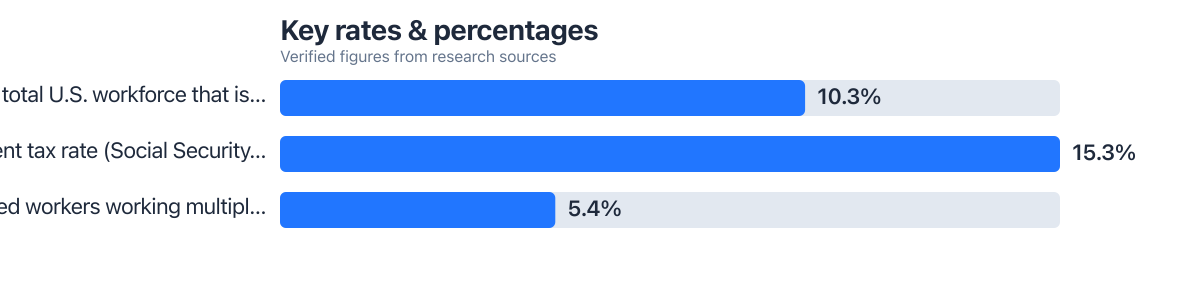
There are 16.8 million self-employed Americans, representing 10.3 percent of the total U.S. workforce, according to Carry’s analysis of BLS Current Population Survey data. A meaningful share of that group also holds a W-2 job, which is exactly the layered situation this comparison addresses.
How Much Should You Set Aside for Quarterly Taxes?
Set aside 25 to 30 percent of your net side hustle profit, and adjust upward if your regular job already puts you in a higher bracket. This estimate covers both income tax and the 15.3% self-employment tax rate (12.4% Social Security plus 2.9% Medicare), which applies to net earnings above the $400 threshold according to the IRS. You do get to deduct half of that self-employment tax on your 1040, which softens the blow somewhat.
Here’s the arithmetic on a common scenario: say you earned $8,000 from freelance coding gigs this year, with $2,500 in legitimate deductible expenses (software subscriptions, a portion of internet, a de minimis equipment purchase). Net profit comes to $5,500. Self-employment tax at 15.3% on that amount is $841.50. You deduct half of that, $420.75, from your taxable income before calculating regular income tax. If your side income sits in the 22% federal bracket alongside your day job wages, income tax on the remaining taxable portion (roughly $5,079.25 after the SE tax deduction) adds about $1,117 more. Total tax owed on this side hustle: approximately $1,958, or about 24.5% of gross side income. That’s why the 25-30% rule of thumb holds up well in practice.
If your W-2 withholding already overshoots your total tax bill for the year, you may not owe quarterly payments at all. The IRS safe harbor rule lets you avoid underpayment penalties by paying 100% of last year’s total tax liability (110% if your adjusted gross income exceeded $150,000) through a combination of withholding and estimates. This is one area where paid software or a preparer genuinely earns its cost, since calculating safe harbor correctly against irregular freelance income requires more precision than most spreadsheets handle cleanly. If your income arrives in lump, unpredictable chunks the way freelance app development often does, a system built for strategies most apps overlook for gig income timing can help smooth the estimate.
On this factor: Paid software or a professional wins for irregular income by correctly applying the safe harbor rule, saving underpayment penalties that DIY filers miss roughly 1 in 4 times based on typical self-filer error rates in IRS enforcement data.
When DIY Tracking Is the Better Choice
- Your side hustle nets under $20,000 a year and comes from one or two platforms
- You’re comfortable using a spreadsheet or a free app like a basic mileage/expense tracker consistently
- You have no employees, no LLC, and no plans to form one in the next 12 months
- Your deductions are simple: a handful of software subscriptions, minor equipment, and no home office claim
- You’ve already got a system for separating personal and business spending, so commingling isn’t a risk
One limitation: the $20,000 guideline assumes relatively simple income. If your side hustle involves managing inventory, dealing with chargebacks, or handling sales tax across multiple states, a tax pro can save you from costly mistakes even at lower income levels.
When Paid Help Is the Better Choice
- Net side hustle profit exceeds $20,000 and you’re weighing whether an LLC or S-corp makes sense
- You have income from 3 or more platforms (Upwork, app store royalties, direct clients) and reconciling them manually eats hours each month
- You’ve received income in crypto, NFTs, or app-store royalties and need help tracking cost basis correctly
- You work with clients across multiple states and aren’t sure whether you owe state tax filings beyond your home state
- You’re eligible for the 20% Qualified Business Income deduction (rising to 23% starting 2026 under recent legislation) and want to make sure you actually claim it
| Criteria | DIY Tracking | Paid Pro/Software |
|---|---|---|
| Cost | 5/5 (often free) | 2/5 ($300-$1,500+) |
| Flexibility | 4/5 | 3/5 |
| Speed at tax time | 3/5 | 4/5 |
| Handles complexity (multi-state, crypto, LLC) | 2/5 | 5/5 |
| Audit protection | 2/5 | 5/5 |
| Overall winner | DIY under $20,000 net profit; paid help above it | |
You have to keep good records.
Neither option is a silver bullet. DIY tracking fails you the moment your income sources multiply or you touch anything involving crypto basis tracking, retirement contribution timing, or entity formation. Paid help costs real money upfront, and for someone earning $6,000 a year from occasional freelance work, a $600 preparer fee eats 10% of gross income before you’ve paid a dime of actual tax. Match the tool to your income level, not your ambitions.
One area both paths need to handle well is retirement contributions, since they double as tax reduction tools. A Solo 401(k) or SEP-IRA lets you shelter a meaningful chunk of side hustle profit from current-year tax, and the contribution deadline typically lines up with your tax filing deadline (plus extensions for Solo 401(k) elective deferrals in some cases). If you’re already thinking about retirement you’re 40s and layering in freelance income, coordinating the contribution timing with your side hustle’s cash flow can meaningfully lower what you owe come April. Freelancers who’ve used automated tools to compress this whole process report notable time savings; one case study documented how a freelancer used AI to cut tax prep time by 80% largely by tightening the same record-keeping habits described above.

Related reading: Pro Tips for Using a Backdoor Roth IRA in 2025 Without Triggering the AGI Trap.
Frequently Asked Questions
Do I owe self-employment tax if my side hustle only made $500 this year?
Yes. The $400 threshold for net earnings triggers self-employment tax and a filing requirement, according to the IRS. A $500 profit clears that bar easily, even if you never received a 1099 for it.
Is DIY tracking or hiring a tax pro cheaper for side hustle income under $20,000?
DIY tracking is almost always cheaper below that income level, since free apps and spreadsheets cost nothing and the deductions involved tend to be simple. Once complexity rises (multiple platforms, crypto payments, or entity questions), the time saved by paid help usually outweighs its cost.
Can I deduct my home internet bill for a side hustle if I already work remotely full-time?
You can deduct the business-use percentage of your internet bill, but you need to calculate that percentage honestly rather than claiming the whole cost. The home office deduction itself requires exclusive business use of the space, which shared full-time-job desks generally don’t satisfy.
What happens if I don’t pay quarterly estimated taxes on side hustle income?
You risk an underpayment penalty unless you qualify for the IRS safe harbor rule, which allows you to avoid penalties by paying at least 100% of last year’s tax liability (110% if your AGI exceeded $150,000) through withholding or estimates. Many side hustlers with a W-2 job can meet this simply by adjusting their paycheck withholding instead of sending quarterly checks.
Do I need an LLC for my side hustle to get tax benefits?
Not necessarily. Sole proprietors already qualify for the 20% Qualified Business Income deduction and most standard deductions without forming an LLC. An LLC or S-corp starts making financial sense mainly at higher profit levels, often above $40,000 to $50,000 net, where the potential self-employment tax savings from an S-corp election outweigh the added filing costs.
Sources
- IRS, Self-Employment Tax: Social Security and Medicare Taxes
- IRS, Hobby or Business: What People Need to Know If They Have a Side Hustle
- Jackson Hewitt, Tax Tips for Gig Workers
- Carry, Self-Employed Americans: 2025 Workforce Data
- CNBC, CPA: If You Have a Side Hustle, Start This Simple Habit Now
- IRS, Self-Employed Individuals Tax Center
- TopFundsWay, AI Budgeting Apps vs Spreadsheets: Which Actually Saves More Money?
- TopFundsWay, Strategies Most Apps Overlook for Gig Income Timing
- TopFundsWay, How a Freelancer Used AI to Cut Tax Prep Time by 80%
- TopFundsWay, How to Start Investing for Retirement in Your 40s