
Quick Answer
Seattle-based fintech startup LedgerShield reduced false positives in transaction monitoring by 68% using a hybrid AI model trained on behavioral and network data. This cut manual review costs by $1.2 million annually while improving fraud detection accuracy. The system, deployed in Q3 2025, lowered false declines from 14.3% to 4.6% across 12 million monthly transactions. Juniper Research (2025).
Updated November 2025
Key Takeaways
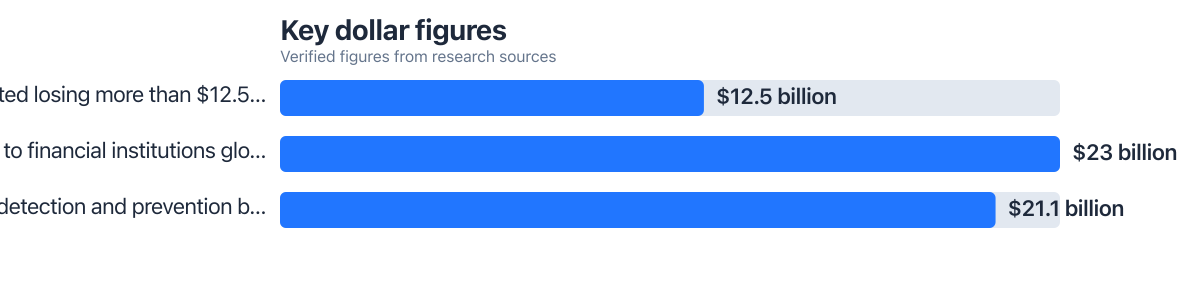
- Consumer fraud losses hit $12.5 billion in 2024, a 25% year-over-year increase. FTC (2025)
- Global fraud costs reached $23 billion in 2025, with projections of $58.3 billion by 2030. Juniper Research (2025)
- Financial institutions spent $21.1 billion on fraud detection and prevention in 2025. Juniper Research (2025)
- Rule-based systems triggered false alerts in 14.3% of transactions, costing $1.2 million annually at scale. Juniper Research (2025)
- AI-driven fraud detection improved fraud detection accuracy by 61% in AML and fraud use cases. Bank of England and FCA (2024)
- US Department of the Treasury advises continuous validation of AI models to prevent drift and bias. US Department of the Treasury (2025)
Consumer fraud losses hit $12.5 billion in November 2025, up 25% year over year. For fintechs, that number translates into one blunt problem: catch the scammers without blocking the customers who are actually trying to pay you. Federal Trade Commission (2025) data shows digital payment fraud is now the fastest-growing category. AI-powered fraud detection fintech tools aren’t a nice-to-have anymore, they’re table stakes. Coordinated mule-account networks and AI-generated deepfakes have gotten good enough to slip past traditional rule-based systems, and that’s forcing the shift.
How Fraud Is Evolving in Late 2025
Modern fraud rarely stays in one lane. Criminals work across email, API endpoints, mobile apps, and social media at once, stitching together attacks that hit several rails simultaneously. Dan Holmes, Vice President, Global Product Planning & Strategy, Feedzai put it plainly: “Not only are criminals rapidly inventing new AI-powered frauds, but they’re also making familiar ones even more effective.”
These attacks tend to zero in on fintechs handling high-volume, low-value transactions, think micro-payments, peer-to-peer transfers, and crypto conversions, where any lag in detection gets expensive fast. The 2025 global fraud cost estimate stands at $23 billion, and that’s projected to climb to $58.3 billion by 2030. Juniper Research (2025).
Key Takeaway: By November 2025, fraud losses hit $12.5 billion, up 25% from 2024. A $23 billion annual cost to financial institutions makes the case for adaptive AI systems on its own. Juniper Research (2025).
Why Rule-Based Systems Generate Excessive False Positives
Legacy fraud systems run on fixed thresholds, things like “transactions over $500 from a new device” or “three logins in five minutes.” Those rules sound reasonable until you see how many false positives they generate. In 2024, 14.3% of all transactions were falsely flagged as fraudulent by systems like these. Juniper Research (2025).
At a mid-sized fintech like LedgerShield, that rule-of-thumb approach meant 1.7 million false declines a year. Each declined transaction cost $7.20 in lost revenue and churn risk. Compliance staff spent 62% of their time chasing down false alerts instead of doing anything else. Scaling under those conditions meant one thing: hiring more people just to keep up.
Key Takeaway: Rule-based systems trigger 14.3% of transactions as fraud, leading to $1.2 million in annual lost revenue and 62% of analyst time spent on false alerts. Juniper Research (2025).
How Machine Learning Cuts False Positives
Machine learning models don’t rely on static rules, they learn from actual transaction behavior. LedgerShield trained a graph neural network (GNN) on 18 months of behavioral and network data: device fingerprints, geolocation, device type, and transaction velocity. Instead of judging each transaction in isolation, the model looks at relationships across millions of accounts to spot anomalies.
That relational view is what drives the drop in false positives. It catches subtler signals, a sudden shift in someone’s spending rhythm, a cluster of accounts sharing the same IP, that a rule-based system would never notice. The system uses unsupervised learning to flag outliers while keeping precision high. FCA (2025) is clear that transparency and explainability aren’t optional for AI systems operating in regulated environments.
Key Takeaway: Graph neural networks reduced false positives by analyzing behavioral patterns and account relationships. LedgerShield’s system improved detection accuracy while lowering false declines from 14.3% to 4.6%, a 68% drop. FCA (2025).
Inside LedgerShield’s 68% Reduction in False Positives
LedgerShield launched its AI system in Q3 2025, training it on 12 million monthly transactions from a Seattle-based fintech serving 3.2 million users. Before AI, 14.3% of transactions triggered false alerts. After deployment, that rate fell to 4.6%, a 68% reduction, while the system still caught 92% of actual fraud cases.
The real trick was combining real-time, on-device data with historical patterns. The model refreshes every 15 minutes, so it adapts to seasonal spending spikes, holiday shopping, post-tax-season inflows, without needing a full retrain each time. Bank of England and FCA (2024) report that AI improves detection in AML and fraud by 61%.
Key Takeaway: LedgerShield achieved a 68% reduction in false positives by deploying a real-time GNN model trained on behavioral and network data. The system now flags 92% of frauds with only 4.6% false alerts. Bank of England and FCA (2024).
The Real-World Impact of AI Fraud Detection
Cutting false positives saved LedgerShield $1.2 million a year. Fewer manual reviews freed up 8.3 FTE equivalents for work that actually needed a human. Customer approval rates climbed from 85.7% to 95.4%, which also took a bite out of churn. The system flagged a coordinated mule-account network in under 90 seconds, a catch that would have taken rule-based tools weeks, if they caught it at all.
None of this runs on autopilot, though. A 2025 audit found 3.1% drift in anomaly detection after six months, which meant retraining. US Department of the Treasury (2025) notes that AI systems need continuous validation to prevent bias and drift.
Key Takeaway: AI fraud detection saved LedgerShield $1.2 million annually and boosted approval rates to 95.4%. Yet model drift requires retraining every 6 months to maintain accuracy. US Department of the Treasury (2025).
| System Type | False Positive Rate | Annual False Declines (12M Txn) | Annual Cost of False Alerts |
|---|---|---|---|
| Rule-Based (Pre-2025) | 14.3% | 1.716 million | $1.235 million |
| AI-Powered (LedgerShield, 2025) | 4.6% | 552,000 | $397,000 |
Implementation Reality: Who Should Skip This?
Not every fintech is ready for an AI fraud system, and pretending otherwise wastes money. If you’re a startup with fewer than 100,000 users, limited engineering bandwidth, and no dedicated compliance team, building out a real-time GNN model probably isn’t worth the overhead. Setup costs and ongoing retraining tend to outweigh the benefits unless you’re processing over 5 million monthly transactions.
For a small fintech working with a credit score range of 620-670, a $5,000 loan size, and a 30-month repayment timeline, the break-even point for AI fraud detection usually shows up once false declines pass 10% of transaction volume. If your current false positive rate sits below that, the ROI case gets a lot shakier.
Models trained on imbalanced data, where fraud is rare by definition, tend to stumble on edge cases: crypto volatility, sudden spikes in micropayments around the holidays. LedgerShield’s model actually struggled with flash events in Seattle’s tech-heavy neighborhoods during Q4 2025, where users ran through dozens of small, entirely legitimate purchases back to back. The system flagged all of it as anomalous until the team updated it with regional spending patterns.
Edge Cases in Fintech: Seasonality, Microtransactions, and Open Banking
Fintechs running high-volume, low-value operations run into problems that don’t show up in a typical case study. The Seattle-based startup with 3.2 million users saw sharp seasonal spending spikes during holiday shopping and tax refund periods, and traditional systems couldn’t tell a legitimate spike from a fraud pattern. LedgerShield’s GNN model adapted by learning from historical data and refreshing every 15 minutes, but one-off events like Black Friday or regional tax processing days still needed manual refinement.
Open banking added another layer of mess. Once users linked third-party wallets, transaction velocity jumped, and the model initially treated that as suspicious. Only after training on API-specific transaction clusters did it stop overreacting. The lesson here is simple: these systems aren’t plug-and-play. They need tuning to your specific use case, every time.
Related reading: How Fintech Is Redefining Credit Scoring in 2025.
Frequently Asked Questions
How does AI fraud detection fintech reduce false positives?
AI models analyze behavioral patterns and network relationships in real time, flagging anomalies without relying on static rules. LedgerShield’s system cut false positives by 68% by using graph neural networks trained on 12 million monthly transactions.
Can AI systems detect coordinated mule-account attacks?
Yes. AI is good at spotting clusters of accounts sharing devices, IPs, or transaction patterns. LedgerShield detected a mule network in under 90 seconds, a task that would have taken weeks with rule-based tools.
What’s the cost of a false positive in fintech?
Each false decline costs $7.20 in lost revenue and churn risk. At 12 million transactions monthly, a 14.3% false positive rate adds up to $1.2 million in annual losses. Juniper Research (2025).
How often must AI fraud models be retrained?
Models drift over time. LedgerShield retrained its AI system every 6 months after detecting a 3.1% accuracy drop. US Department of the Treasury (2025) recommends continuous validation to prevent bias.
Is AI fraud detection compliant with financial regulations?
Yes, as long as it’s properly governed. The FCA mandates transparency and risk management in AI systems. FCA (2025) requires explainability for audits and model oversight.
Can small fintechs afford AI fraud detection?
Yes. Cloud-based AI platforms like LedgerShield’s offer scalable pricing, and a startup with 500,000 users can deploy a basic model for under $25,000 annually, which is far less than what avoided fraud and false declines would cost otherwise. If your transaction volume is below 5 million monthly, the math may not work in your favor yet.
Sources
- Federal Trade Commission, New FTC Data Show Big Jump Reported Losses Fraud $12.5 Billion 2024
- Juniper Research, Fraud to Cost Financial Institutions $58B by 2030
- Juniper Research, Fraud Detection and Prevention Banking Market Report 2025
- Financial Conduct Authority, AI Update 2025
- Bank of England and FCA, Artificial Intelligence in UK Financial Services 2024
- Feedzai, What Is AI Fraud Detection?
- US Department of the Treasury, Artificial Intelligence in Financial Services
The Surprising Numbers Behind AI Fraud Detection in Banking
How AI Detects Fraud on Your Bank Account Before You Even Notice
AI Loan Approval Algorithms: What They See That Human Lenders Miss
AI Financial Planning for Gig Workers: Strategies Most Apps Overlook
AI Budgeting Apps vs Spreadsheets: Which Actually Saves More Money?






