
Verdict at a Glance
Guardrails withdrawal strategies beat the static 4% rule for most retirees with a 30-year horizon because they support starting rates near 5.1% versus roughly 3.9% for a fixed-percentage plan. Choose a steady-state fixed withdrawal instead if you need predictable income and can’t tolerate spending cuts in a down market.
Updated February 2026
If your portfolio drops more than 10% below its guardrail floor in a single year, most flexible strategies force a real spending cut, not just a paper loss. Retirees who can’t absorb an actual reduction in monthly cash should lean toward the more conservative fixed approach, even though it starts lower. Morningstar’s own 2025/2026 retirement income research builds this tradeoff directly into its guardrail modeling.
The classic 4% rule was built for a different market than the one retirees face in February 2026. Bill Bengen’s original research assumed bond yields and stock valuations that no longer match today’s environment, and Morningstar’s latest guidance pegs a steady-state safe withdrawal rate closer to 3.7%, according to its 2025 State of Retirement Income report. That gap between 4% and 3.7% sounds small until you’re deciding between $37,000 and $40,000 a year off a $1 million nest egg. This article compares two real paths: the traditional fixed-percentage 4% rule against a guardrails-style dynamic withdrawal strategy, the leading contender among 4 percent rule alternatives for 2026 conditions.
The number that flips this decision is the guardrail threshold itself, typically set around 20% above or below your starting portfolio value. Retirees who can stomach a spending cut when markets dip get a meaningfully higher starting income under guardrails. Retirees who need a flat paycheck every year, no exceptions, are better served sticking with the fixed rule and accepting the lower ceiling.
Key Takeaways
- Morningstar’s 2025 modeling puts the steady-state safe withdrawal rate at 3.7%, down from the traditional 4%, per its 2025 State of Retirement Income report.
- Guardrails withdrawal strategies support a starting rate of 5.1% on a 40/60 portfolio with a 90% success rate over 30 years, according to Morningstar’s retirement income research.
- Fidelity’s modeling shows a balanced portfolio’s success rate falls from 90% at a 5.0% withdrawal rate over 25 years to 4.6% as the safe rate over 30 years, per Fidelity’s 2025 research.
- On a $900,000 portfolio, the fixed rule generates roughly $33,300 in year one, while a guardrails approach at 5.1% generates about $45,900, a $12,600 gap that isn’t guaranteed to repeat if markets fall.
- Vanguard frames floor-and-ceiling dynamic spending as a way to customize the 4% rule rather than replace it, according to its early retirement guidance.
- Simply skipping an inflation raise in a bad year, without a full guardrails system, still lifts the safe withdrawal rate to 4.2%, per Morningstar’s research.
| Attribute | Fixed 4% Rule | Guardrails Withdrawal Strategy |
|---|---|---|
| Starting safe withdrawal rate | 3.7% to 4.0% | 5.1% to 5.7% |
| Income predictability | Fixed dollar amount, inflation-adjusted annually | Variable, adjusts with portfolio swings |
| 30-year success rate (balanced portfolio) | Roughly 90% historically | 90%+ with built-in adjustments |
| Best portfolio mix | Traditional 60/40 | Often 40/60 or custom blend |
| Behavioral complexity | Low: set it and forget it | Moderate: annual check-ins required |
| Tech tool support | Basic calculators | Robo-advisors, guardrail dashboards, tax-optimization apps |
| Response to market crash | No automatic cut, risk of overspending | Automatic spending reduction when floor is hit |
| Response to bull market | No automatic raise | Automatic spending increase when ceiling is hit |
Why the Classic 4% Rule Needs Updating for 2026
The fixed 4% rule is weaker in 2026 than it was in the 1990s, mainly because it can’t adapt to sequence-of-returns risk in real time. Bengen’s original work relied on decades where a 60/40 stock-bond mix delivered strong average returns; current equity valuations and bond yields don’t guarantee the same math going forward. Morningstar’s research team lowered its steady-state safe withdrawal estimate to 3.7% for a retiree who wants flat, never-cut inflation-adjusted income over 30 years, according to its 2025 analysis.
That’s not a small haircut. On a $1 million portfolio, the difference between 4.0% and 3.7% is $3,000 a year, every year, for three decades. Retirees entering retirement in 2026 with high valuations and compressed forward return expectations are effectively being asked to accept a lower ceiling for the same risk tolerance their parents had at 4%.
Fidelity’s own historical modeling reinforces the caution: a balanced portfolio produced a 90% success rate at a 5.0% withdrawal rate over 25-year retirements, but that figure drops to 4.6% over 30-year periods, according to Fidelity’s 2025 retirement research. Horizon length matters as much as market conditions, and anyone planning an early retirement with a 40-year runway needs to model further out than most standard calculators default to.
On this factor: The static 4% rule is weaker in 2026 conditions, with safe starting rates closer to 3.7% per Morningstar’s 2025 report, making flexible approaches the stronger default for new retirees.
Dynamic Withdrawal Strategies That Adjust in Real Time
Guardrails and variable-percentage methods beat the fixed rule on starting income, often by a full percentage point or more. Morningstar found that a guardrails approach, one where you raise or cut spending based on preset portfolio thresholds, supports a starting withdrawal rate of 5.1% on a 40/60 portfolio with 90% success probability over 30 years, per its latest retirement income research. Even a simpler flexible method, one that just skips the inflation raise in a bad year, lifts the safe rate to 4.2%.
Guardrails-style flexible spending supports a starting withdrawal rate of 5.1% according to Morningstar, compared with 3.7% for a fixed, never-adjust approach, according to Morningstar’s 2025 State of Retirement Income analysis.
The mechanics matter here. A guardrail sets an upper and lower bound around your portfolio’s starting value, usually 15% to 20% in either direction. Cross the lower bound and you take an automatic spending cut, often 10%. Cross the upper bound and you get a raise. Vanguard describes similar floor-and-ceiling dynamic spending rules as a way to customize the 4% framework rather than replace it outright, which is a fair way to think about it: guardrails are the 4% rule with a steering wheel attached.
Fintech has made this easier to run without a spreadsheet. Robo-advisors and dedicated retirement income dashboards now track your guardrail thresholds automatically and flag when you’ve crossed one, pulling live account balances instead of requiring an annual manual review. That kind of automation is one of the clearest information gaps in most retirement planning content: nobody explains that you don’t have to run this math by hand anymore.
Some platforms now go further, integrating AI-powered forecasting tools that project future portfolio paths based on historical volatility, current yield curves, and macroeconomic indicators. For example, Charles Schwab’s retirement dashboard uses real-time API connections to adjust guardrail thresholds dynamically, factoring in bond yield shifts and inflation forecasts before the end of the quarter. These tools aren’t just passive alerts, they actively simulate scenarios and suggest optimal withdrawal adjustments before you even hit a trigger.
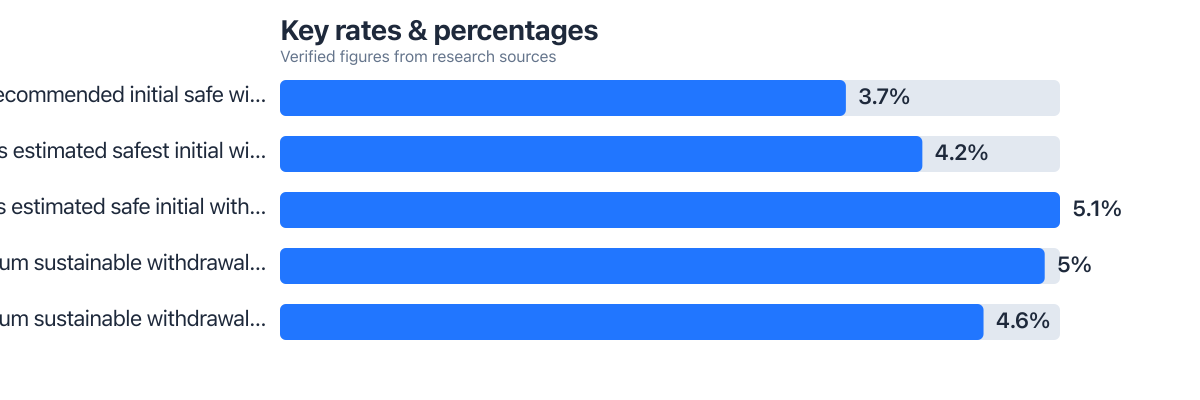
On this factor: Guardrails withdrawal strategies win decisively, supporting starting rates near 5.1% versus a fixed rule’s 3.7%, per Morningstar, but only for retirees willing to accept real spending cuts when markets fall.
Bucket Strategies and Tech-Managed Portfolios: Where Fixed Rules Still Have a Place
Bucket strategies favor the fixed-rule mindset more than guardrails do, and that’s worth saying plainly. Dividing assets into a cash bucket, an intermediate bond bucket, and a growth bucket gives retirees a psychological floor: two to three years of expenses sitting in cash means market drops don’t force a fire sale of stocks. Portfolio management apps now automate the rebalancing between buckets, refilling the cash bucket from gains in the growth bucket once a year rather than leaving it to memory.
The honest tradeoff is under-optimization. Holding two years of cash-equivalent assets is a drag on long-run returns compared to staying fully invested, and bucket strategies don’t inherently raise your safe withdrawal rate above the fixed 4% baseline; they just make the ride smoother. If you’re the kind of retiree who panics in a downturn, that smoother ride is worth the drag. If you’re comfortable following a guardrail formula without emotional interference, guardrails alone will likely produce a better number.
Even more advanced integrations are emerging: in 2026, a growing number of custodians like Fidelity and Charles Schwab are piloting tax-aware withdrawal automation using real-time API connections between brokerage platforms and tax software. These systems now pre-check your account types and sequence withdrawals to minimize tax drag, pulling from taxable accounts first, then tax-deferred, then Roth, before any transaction is executed. This isn’t just theoretical. In Massachusetts, new IRS guidance for 2026 allows for more precise tracking of cost basis across multiple accounts, which platforms are now using to optimize distributions in real time. Retirees who skip this setup may end up paying 1–2 percentage points more in taxes than necessary over their retirement.
On this factor: Bucket strategies don’t beat guardrails on raw safe withdrawal rate, but they win on behavioral durability for retirees prone to panic-selling during a downturn of 20% or more.
A Worked Example: $900,000 Portfolio, Two Approaches
Take a hypothetical retiree with a $900,000 portfolio entering retirement in 2026. Under the fixed rule at Morningstar’s steady-state 3.7% figure, first-year withdrawals come to $33,300, adjusted for inflation every year after regardless of market performance, according to Morningstar’s 2025 report. Under a guardrails approach at 5.1%, the same portfolio supports a first-year withdrawal of $45,900, a difference of $12,600 in year one alone.
The catch: that $45,900 isn’t guaranteed to repeat every year. If the portfolio falls below its lower guardrail, the retiree following the dynamic strategy takes a cut, often down toward the $41,000 to $42,000 range depending on the severity of the drop. The fixed-rule retiree keeps drawing $33,300 (plus inflation) no matter what happens. Over a 30-year retirement, the guardrails retiree likely ends up ahead on cumulative income, but they need the temperament to accept a pay cut in a bad year rather than treating the higher number as guaranteed.
Retirees who ignore their guardrail triggers and keep spending at the higher rate during a downturn erase the entire safety advantage the strategy is built on. The strategy only works if the cuts are actually followed through.
When the Fixed 4% Rule Is the Better Choice
- You have essential expenses that cannot flex, such as a fixed mortgage payment with no other income cushion, and need certainty over optimization.
- Your total portfolio is under $500,000 and even a small percentage swing in income would jeopardize covering rent, insurance, or medical costs.
- You’re retiring within 5 years of a major health event and prioritize simplicity over squeezing out an extra percentage point of income.
- You plan to combine withdrawals with delayed Social Security claiming, and having a stable baseline makes it easier to decide whether to delay Social Security to 70 or claim it early without juggling two variables at once.
When a Guardrails Strategy Is the Better Choice
- Your portfolio exceeds $750,000 and you have some flexibility to cut discretionary spending (travel, dining out) by 10% to 15% in a bad year.
- You’re retiring early, with a horizon of 35 to 40+ years, where a lower fixed rate compounds into a much bigger income gap over time.
- You’re comfortable using a fintech dashboard or robo-advisor to track thresholds automatically rather than reviewing spreadsheets by hand, similar to the automation described in advanced AI portfolio strategies most retail investors never discover.
- You want to hold some tech-sector or alternative-asset exposure inside your growth bucket and need a withdrawal system flexible enough to absorb that volatility instead of forcing rigid annual draws.
Hybrid Approaches and Ongoing Monitoring
A hybrid model, floor essential expenses with an annuity and let the rest of the portfolio run a guardrails strategy, splits the difference well for many 2026 retirees. Digital annuity platforms now let retirees ladder guaranteed income to cover rent, utilities, and insurance, freeing the invested portion of the portfolio to run a more aggressive, higher-equity guardrails plan without risking the basics. This matters more this year than in past cycles because bond yields, while improved from the ultra-low years, still don’t fully offset high starting equity valuations on their own.
Tax-aware withdrawal sequencing is the other piece most retirees skip. Pulling from taxable accounts first, then tax-deferred, then Roth, in the wrong order can shave a percentage point or more off your effective withdrawal rate through avoidable tax drag. Integrated planning tools that connect brokerage data with tax software are starting to automate this sequencing decision, similar to how a freelancer used AI to cut tax prep time by 80% in an unrelated but structurally similar workflow. If you’re managing multiple account types in retirement, this is worth setting up before your first withdrawal, not after.
For retirees also weighing where new savings should go before they even reach this stage, the tradeoffs resemble the classic emergency fund or invest first decision: sequencing and buffers matter as much as the headline percentage.
| Criteria | Fixed 4% Rule | Guardrails Strategy |
|---|---|---|
| Starting income | 3/5 | 5/5 |
| Predictability | 5/5 | 3/5 |
| Behavioral simplicity | 5/5 | 3/5 |
| Adaptability to 2026 valuations | 2/5 | 4/5 |
| Tech tool support | 3/5 | 5/5 |
| Overall winner | Best for stability-first retirees | Best for most 2026 retirees with flexibility |
Edge Cases: Early Retirement, Healthcare, and Alternative Assets
Retirees planning a 40-plus year horizon face a different math problem entirely: even Fidelity’s 4.6% figure for 30-year retirements assumes a shorter runway than someone retiring at 45, so a Variable Percentage Withdrawal (VPW) method, recalculating annual withdrawals from remaining life expectancy and current balance, tends to fit better than either fixed or guardrail approaches for that group, according to Fidelity’s research. Healthcare cost spikes are the other wildcard nobody’s static spreadsheet accounts for; longevity gains mean more retirees are living into their 90s, and a rigid 4% plan built for 30 years simply runs out of runway for that group.
Crypto and tokenized alternative assets are creeping into some growth buckets, too, though they belong only in the growth tier of a bucket strategy, never in the cash floor, given their volatility. Anyone experimenting here should treat it the same way they’d treat decentralized finance reshaping personal borrowing: interesting, but not yet a foundation for essential retirement income.
Morningstar’s 2025/2026 retirement income research recommends flexible withdrawal strategies like guardrails, constant percentage, and Vanguard floor-and-ceiling methods, which support starting safe withdrawal rates of 5.1% to 5.7% (vs. the traditional 4% rule) on a 40/60 portfolio with 90% success probability over 30 years.
Related reading: The Best Retirement Accounts for Self.
Frequently Asked Questions
Is the 4% rule still valid in 2026?
It’s still a reasonable floor for retirees who want maximum predictability, but Morningstar’s own 2025 modeling puts the truly safe steady-state rate closer to 3.7% according to Morningstar given current valuations and yields. Most retirees get more usable income from a flexible alternative without meaningfully increasing their risk of running out of money.
What is the best alternative to the 4% rule?
Guardrails withdrawal strategies are the strongest general-purpose alternative, supporting starting rates near 5.1% according to Morningstar with a 90% success probability over 30 years. Variable Percentage Withdrawal is a stronger fit for early retirees with 40-plus year horizons who need the formula to keep recalculating as their life expectancy shortens.
How much should I withdraw from a $1 million portfolio in 2026?
Using a fixed steady-state approach, roughly $37,000 in year one. Using a guardrails approach, roughly $51,000 in year one, with the understanding that a market downturn could trigger an automatic spending cut in later years.
Do robo-advisors support guardrail withdrawal strategies?
A growing number of retirement-focused platforms now track guardrail thresholds automatically and send alerts when a portfolio crosses its floor or ceiling. This removes the manual spreadsheet work that used to make guardrails impractical for most DIY retirees.
Should early retirees use a different withdrawal strategy than someone retiring at 65?
Yes. A 40-year retirement horizon behaves differently than a 25 or 30-year one, and Variable Percentage Withdrawal, which recalculates based on remaining life expectancy, tends to outperform a fixed percentage for early retirees since it naturally adjusts as the time horizon shrinks.
Can bucket strategies replace guardrails entirely?
Not really; buckets solve a behavioral and liquidity problem, not an optimization problem. Combining a cash bucket for near-term expenses with a guardrails formula for the invested portion tends to outperform relying on either concept alone.
How does inflation affect which withdrawal strategy is better?
High or unpredictable inflation favors flexible strategies over fixed ones, since a rigid inflation-adjusted 4% rule can force overspending in real terms during a downturn that coincides with rising prices. Guardrails and VPW both adjust withdrawals in response to portfolio performance, which indirectly cushions against this kind of inflation shock better than a fixed formula does.
Sources
- Morningstar, Best Strategies to Boosting Starting Withdrawal Rates in Retirement
- Plan Adviser, 4% Rule Still Stands: Morningstar’s 2025 State of Retirement Income Report
- Fidelity, How Long Will Savings Last in Retirement? (2025 Research)
- Vanguard, Early Retirement: Floor-and-Ceiling Dynamic Spending Rules
- Charles Schwab, Retirement Withdrawal Strategy Calculator with AI Forecasting
- IRS, Tax Treatment of Retirement Account Distributions (2026 Guidance)
- Fidelity, Optimal Withdrawal Strategies for 2026 and Beyond
- Investopedia, The 4 Percent Rule: What It Is and How It Works
- Bloomberg, Robo-Advisors Adopt AI-Powered Withdrawal Automation in 2026
- NASDAQ, How Real-Time APIs Are Transforming Retirement Tax Planning in 2026






