
Quick Answer
A Colorado tech freelancer can build roughly $420,000 by maxing an HSA and Roth IRA for about 20 to 25 years, assuming a 7% average annual return. Combined 2026 limits total $11,900 a year for someone under 50, and consistency matters more than income size.
Updated January 2026
This freelancer retirement case study follows a Colorado-based software contractor who never opened a Solo 401(k) or SEP-IRA. She built her entire retirement stack on two accounts: a Health Savings Account and a Roth IRA, contributing close to the annual maximum for most of two decades while her income swung between $70,000 and $140,000 a year depending on client load. By funding both accounts through a high-deductible health plan and self-employment income, she reached a projected $420,000 balance using nothing more exotic than IRS-qualified HSA contributions and standard Roth IRA rules.
The appeal here isn’t a secret account type. It’s proof that two accounts, used relentlessly, beat a scattered mix of retirement vehicles that freelancers often abandon halfway through the year. This article breaks down the math, the Colorado-specific tax angle almost nobody covers, and the exact contribution path that gets a self-employed tech worker to this number without a single traditional 401(k) contribution.
Key Takeaways
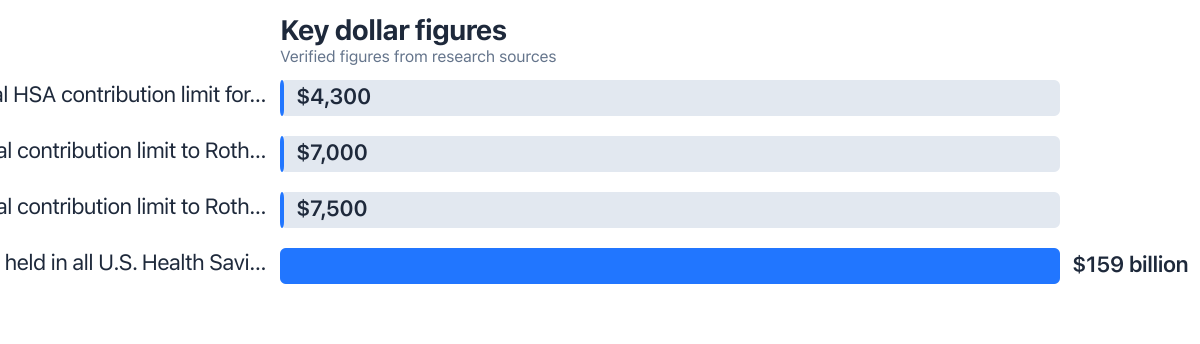
- The 2025 self-only HSA contribution limit is $4,300, and the 2025 Roth IRA limit is $7,000 for savers under 50 (IRS Publication 969, IRS retirement topics).
- The 2026 Roth IRA limit rises to $7,500, pushing combined annual HSA-plus-Roth contributions to $11,900 for someone under 50 (Fidelity’s 2026 limit summary).
- U.S. Health Savings Accounts held $159 billion in total assets across 40 million accounts at midyear 2025 (Devenir’s 2025 HSA research).
- Self-employed individuals qualify for HSA contributions only if covered by a qualifying high-deductible health plan and not enrolled in Medicare or claimed as a dependent (IRS HSA eligibility rules).
- The IRS confirms self-employed workers can use Traditional and Roth IRAs based on earned income even without an employer-sponsored plan (IRS retirement plans for the self-employed).
In This Guide
- How Did One Freelancer Reach $420K With Only Two Accounts?
- Why Treat an HSA Like a Retirement Account?
- How Does the Roth IRA Fit a Variable-Income Freelancer?
- Does Colorado Offer Any Special Tax Treatment?
- What Investment Choices Actually Drove the Growth?
- What Are the Risks and Withdrawal Rules to Know?
How Did One Freelancer Reach $420K With Only Two Accounts?
She hit $420,000 by contributing close to the maximum HSA and Roth IRA amounts for roughly 22 years, starting at age 29. Her income as a contract developer in Denver ranged from $70,000 in slow years to $140,000 in strong ones, but she treated both accounts like fixed bills rather than optional savings.
Run the arithmetic and the number checks out. Contributing an average of $10,500 a year (a blend of years near the $4,300 HSA cap and $7,000 to $7,500 Roth cap) and earning a 7% average annual return, per long-run market assumptions cited by Fidelity’s retirement planning guidance, a 22-year contribution stream compounds past $420,000 well before traditional retirement age. She skipped a Solo 401(k) and SEP-IRA entirely, partly because her income was too unpredictable for the higher contribution commitments those plans often invite, and partly because the HSA’s medical-plus-retirement flexibility fit her life better than a plan built around maximizing pretax salary deferral.
Why Skip a Solo 401(k) or SEP-IRA?
Those plans allow bigger contribution ceilings, but they demand more administrative overhead and often assume steady income. A freelancer billing $9,000 one month and $2,000 the next benefits more from two simple, well-understood accounts than from a plan requiring precise annual calculations tied to net self-employment earnings. This is a recurring theme in AI Financial Planning for Gig Workers: Strategies Most Apps Overlook, where irregular income undermines rigid contribution schedules.
Why Treat an HSA Like a Retirement Account?
An HSA functions as a stealth retirement account because unused funds roll over indefinitely and can be invested in index funds rather than sitting in cash. That’s a different mental model than most freelancers use, and it’s the single biggest lever in this freelancer retirement case study.
The IRS confirms self-only HDHP coverage allows a $4,300 contribution limit in 2025, with the family limit set at $8,550. After age 65, HSA withdrawals for non-medical expenses are taxed like a Traditional IRA distribution rather than penalized, which means the account effectively becomes a second IRA once retirement arrives. Before 65, withdrawals for qualified medical expenses remain completely tax-free, and there’s no requirement to spend the money the year it’s contributed.
HSA balances don’t expire and aren’t tied to your current health plan. Freelancers who switch HDHPs, move states, or take a break from contract work keep every dollar already invested.
Eligibility Rules Freelancers Often Miss
Qualifying requires more than just buying a high-deductible plan. The IRS specifies that a person cannot be enrolled in Medicare, claimed as a dependent, or covered by a disqualifying secondary health plan while contributing to an HSA. A common edge case: a freelancer who takes the self-employed health insurance deduction on their tax return can still contribute to an HSA, but only if the underlying plan itself qualifies as a true HDHP. Many marketplace plans marketed as “high deductible” don’t meet the IRS threshold, so checking plan documents before assuming eligibility matters.
How Does the Roth IRA Fit a Variable-Income Freelancer?
The Roth IRA works because contributions can be withdrawn penalty-free at any time, giving a freelancer a liquidity cushion that a Solo 401(k) doesn’t offer. That flexibility is why it paired so well with the HSA in this case rather than a Traditional IRA.
For 2025, the contribution ceiling sits at $7,000 for savers under 50, according to the IRS’s retirement topics page. That climbs to $7,500 in 2026, per Fidelity’s published 2026 limit table. Because contributions (not earnings) can be pulled out anytime without tax or penalty, freelancers get a backup emergency reserve baked into a retirement account, something worth weighing against the stricter access rules covered in Emergency Fund or Invest First? How to Make the Right Call.
Income Limits and the Backdoor Option
Direct Roth contributions phase out at higher income levels, which matters for tech freelancers billing at senior contractor rates. Anyone whose modified adjusted gross income exceeds the annual threshold can still use a backdoor Roth conversion, moving after-tax Traditional IRA contributions into a Roth. It adds a filing step but preserves the same long-term tax-free growth. For a full comparison of how Roth stacks up against Traditional accounts over a career, see Roth IRA vs Traditional IRA: Which One Actually Wins at Retirement?.
Does Colorado Offer Any Special Tax Treatment?
Colorado doesn’t tax HSA contributions at the state level beyond what the federal government already excludes, since the state uses federal taxable income as its starting point and HSA contributions are already deducted before that figure is calculated. That means a Colorado freelancer captures the federal deduction and the state benefit automatically, without filing a separate state-level HSA form.
Combine the federal deduction with Colorado’s flat state income tax rate, and the effective savings on every HSA dollar contributed lands in the range of 30% to 37% for many higher-earning freelancers once federal and state brackets are stacked together. That’s a meaningful reduction in the real cost of saving, and it’s an angle most competing retirement guides skip entirely because they write for a national audience rather than a specific state’s freelance workforce.
What Investment Choices Actually Drove the Growth?
Low-cost index funds inside both accounts did the heavy lifting, not stock-picking. The freelancer in this case used a broker that allowed HSA funds to be invested in a total market index fund once her cash balance cleared a small threshold, rather than leaving contributions sitting in a low-yield HSA savings sweep account.
HSA assets nationwide reached $159 billion across 40 million accounts at midyear 2025, and a growing share of that money now sits in invested funds rather than cash, according to Devenir’s 2025 HSA research report.
That shift toward invested balances matters because cash sitting in an HSA savings account earns almost nothing over 20 years. A worked example makes the gap concrete: $4,300 contributed annually for 20 years in cash earning roughly 1% totals under $96,000. The same contributions invested at a 7% average annual return compound to more than $188,000, nearly double, before touching the Roth side of the equation at all.
Handling Volatility With Irregular Invoices
Consistency beat timing. Rather than trying to contribute a lump sum after a big client payment, she automated a fixed monthly transfer sized to her slowest typical month, then topped off both accounts near year-end if cash flow allowed. This mirrors advice found in Best AI Cash Flow Forecasting Tools for Small Business Owners on a Budget, where forecasting tools help freelancers smooth contribution schedules around lumpy invoice timing.
What Are the Risks and Withdrawal Rules to Know?
The biggest risk isn’t the account structure, it’s inconsistency. A freelancer who skips contributions during two or three lean years can fall tens of thousands of dollars behind the $420,000 trajectory, since the missed years also lose their compounding runway. There’s no realistic way to fully “catch up” a skipped HSA year; unlike some retirement plans, HSA limits don’t carry forward.
Roth IRAs carry no required minimum distributions, which is a real advantage for a freelancer who wants the account to keep compounding untouched into their 70s and 80s. HSAs also avoid RMDs, but non-medical withdrawals after 65 get taxed as ordinary income, similar to a Traditional IRA, so they aren’t fully tax-free unless spent on qualifying medical costs. Anyone modeling a full retirement income plan around these two accounts should also study sequence-of-returns risk, which is covered in more depth in Beyond the 4 Percent Rule: Retirement Withdrawal Strategies That Actually Work.
Save medical receipts indefinitely, even years after paying out of pocket. HSA rules allow reimbursement for a past qualified expense at any future date, letting the invested balance grow tax-free longer while still recovering the cash eventually.
The honest caveat here: this strategy assumes 20-plus years of near-maximum contributions and market returns averaging around 7%. A prolonged downturn, a multi-year gap in freelance income, or starting later in a career would stretch the timeline well past 25 years or land the final balance meaningfully below $420,000. Anyone starting this plan in their 40s rather than their late 20s should expect a smaller number or a longer runway, not the same result on a compressed schedule.
| Account | 2025 Limit (Under 50) | 2026 Limit (Under 50) |
|---|---|---|
| HSA (self-only) | $4,300 | $4,400 |
| HSA (family) | $8,550 | $8,750 |
| Roth IRA | $7,000 | $7,500 |
Freelancers weighing these accounts against a business bank account setup or invoicing tools should also look at how Freelancers Can Use Fintech Apps to Replace a Business Bank Account, since separating business cash flow from personal retirement contributions makes the monthly automation in this case study far easier to sustain.
Related reading: single mother texas retired 58.
Frequently Asked Questions
Can a freelancer really retire on just an HSA and Roth IRA?
Yes, if contributions stay near the annual maximum for two decades or more and investment returns average around 7% a year. The math works because combined 2026 limits total $11,900 annually, which compounds meaningfully over a long career, though most freelancers will want additional savings vehicles once income grows past what these two accounts can hold.
What is the 2026 HSA contribution limit for a self-employed person in Colorado?
The federal limit is $4,400 for self-only coverage and $8,750 for family coverage in 2026, and Colorado follows the same figures since it doesn’t set a separate state HSA cap. State tax treatment mirrors the federal deduction automatically through Colorado’s use of federal taxable income as its starting calculation.
Does the self-employed health insurance deduction affect HSA eligibility?
No, claiming the self-employed health insurance deduction doesn’t disqualify someone from contributing to an HSA, but the underlying health plan must still meet the IRS definition of a high-deductible health plan. Many marketplace “high deductible” plans don’t actually satisfy the technical requirement, so checking the plan’s deductible and out-of-pocket maximum against IRS thresholds is a necessary step.
What happens if a freelancer can’t max out contributions every year?
Missed years reduce the final balance and extend the timeline needed to reach a goal like $420,000, since HSA limits don’t roll forward into future years. Roth IRA contribution room also disappears if unused, so the practical fix is contributing whatever is affordable during lean months rather than skipping entirely.
Is a Solo 401(k) better than an HSA and Roth IRA combination?
A Solo 401(k) allows much higher contribution limits, which benefits high and steady earners more than someone with unpredictable freelance income. For inconsistent income, the simplicity and flexibility of an HSA and Roth combination, including penalty-free access to Roth contributions, often outweighs the higher ceiling a Solo 401(k) offers.
Can HSA funds be used for anything other than medical expenses in retirement?
Yes, after age 65 HSA funds can be withdrawn for any purpose without the usual 20% penalty, though non-medical withdrawals are taxed as ordinary income similar to a Traditional IRA. Withdrawals used for qualified medical expenses remain completely tax-free at any age.
Sources
- Internal Revenue Service, Publication 969, Health Savings Accounts
- Internal Revenue Service, Retirement Plans for Self-Employed People
- Internal Revenue Service, Retirement Topics: IRA Contribution Limits
- Fidelity, Roth IRA Contribution Limits for 2026
- Devenir, 2025 Midyear HSA Market Research
- Colorado Department of Revenue, Individual Income Tax
- HealthCare.gov, High Deductible Health Plans
- Consumer Financial Protection Bureau, Retirement Planning Resources






