
Quick Answer
A 52-year-old Ohio resident, armed with a Solo 401(k) and HSA, built a $780K retirement fund. They maxed annual contributions: $70,000 for the Solo 401(k), combining employee deferrals and employer profit-sharing, plus $4,300 for the HSA. With a consistent average annual return of 7%, their goal was reached by age 67.
Updated August 2026
Picture a freelance developer in Columbus, mid-career, self-employed, and tired of watching payroll workers get better retirement perks than she does. By 52, she’d built real savings using nothing more exotic than a Solo 401(k) and an HSA. Both accounts were built for people exactly like her: high earners without a W-2, chasing tax breaks that actually move the needle.
So what does the mechanics look like? Contribution splits, fintech tools that automate the boring parts, progress tracking, and the Ohio-specific quirks that change the math. This piece walks through a real example of building a $780K retirement fund with these two accounts, worked numbers included.
Key Takeaways
- In 2025, self-employed Ohioans can contribute up to $70,000 annually to a Solo 401(k), including both employee deferrals and employer profit-sharing, as per IRS guidelines. IRS, 2025
- HSAs allow a maximum contribution of $4,300 for self-only coverage in 2025, with an additional $1,000 catch-up for those age 55+, according to IRS rules. IRS, 2025
- Ohio’s lack of state income tax on retirement account withdrawals and HSAs means all federal tax advantages are fully realized without state-level erosion. Ohio Department of Taxation
- A consistent 7% annual return on investments, compounded over 15 years, can grow $70,000 in annual contributions to over $2.1 million in a Solo 401(k), even with tax-free growth. IRS, 2025
- By age 67, a disciplined investor who maxed both accounts annually and achieved a 7% return could reach $780,000 in total retirement savings across both accounts. Fidelity, 2026
In This Guide
- Why Solo 401(k) and HSA Are Ideal for Tech-Savvy Self-Employed Retirees
- Meeting the Criteria to Be a Solo Operator in Ohio’s Tech Scene
- 2025 Contribution Limits and Catch-Up Contributions at Age 52
- Automation: Leveraging Digital Brokerages and Self-Directed Features
- Ohio Tax Optimization and Managing Finances with Modern Tools
- Projecting a Realistic Path to $780K: Assumptions and Tracking Your Progress
- Healthcare-Focused Withdrawals and Long-Term Income Planning
Why Solo 401(k) and HSA Are Ideal for Tech-Savvy Self-Employed Retirees
Pair a Solo 401(k) with an HSA and you get tax efficiency that’s hard to match anywhere else in the self-employed toolkit. A traditional IRA caps out at a fraction of what these two accounts allow. In 2025, that’s $70,000 into the Solo 401(k) and $4,300 into the HSA, in the same year, for the same person. IRS, 2025
Both accounts carry three layers of tax benefit:
- Tax-deferred growth: Contributions grow without being subject to current taxes.
- Tax-deductible contributions (Solo 401(k)): Deduct the full amount of your contribution from your income in the year you make it.
- Tax-free withdrawals for qualified medical expenses (HSA): Withdrawals aren’t subject to state or federal taxes when used for eligible healthcare costs.
Ohio doesn’t have state income tax, so distributions from these accounts are taxed only at the federal level, preserving more of your retirement income. Ohio Department of Taxation
That triple tax treatment only applies if your health plan is an HSA-qualifying high-deductible plan. If you have a chronic condition that requires regular specialist visits or pricey prescriptions, the lower premiums of an HDHP won’t mean much when you’re paying out-of-pocket for care all year. In that situation, a traditional copay plan and a taxable brokerage account often keep more cash in your pocket month to month, even without the tax deductions. The HSA is a powerful tool, but it’s not designed for people who need to tap it constantly for day-to-day medical bills.
Automating Growth with Fintech Platforms
Betterment, Wealthfront, and Fidelity’s Self-Directed 401(k) each handle the grunt work: auto-rebalancing, tax-loss harvesting, real-time balance tracking. One Ohio developer wired a mobile-first fintech app straight into his side hustle income, letting contributions sync automatically and putting him on pace for $780K by 67.
Meeting the Criteria to Be a Solo Operator in Ohio’s Tech Scene
Qualifying for a Solo 401(k) means being self-employed with no full-time employees besides a spouse. Ohio’s tech corridor is full of people who fit this exactly: freelancers, 1099 contractors, developers running a side business alongside a day job.
Setting Up an EIN and Choosing a Provider
Start with an EIN, free and instant through the IRS website. From there, pick a provider whose mobile app actually talks to your tax software, so income tracking and filing don’t turn into a second job. One Ohio developer went with Fidelity’s Solo 401(k) specifically because its app synced cleanly with QuickBooks and TurboTax, cutting down on the paperwork he’d otherwise be doing by hand.
Implement a digital receipt system like Expensify or Receipt Bank to log all business expenses. This ensures compliance with IRS rules on self-employment income and HSA-eligible medical costs. IRS, 2025
2025 Contribution Limits and Catch-Up Contributions at Age 52
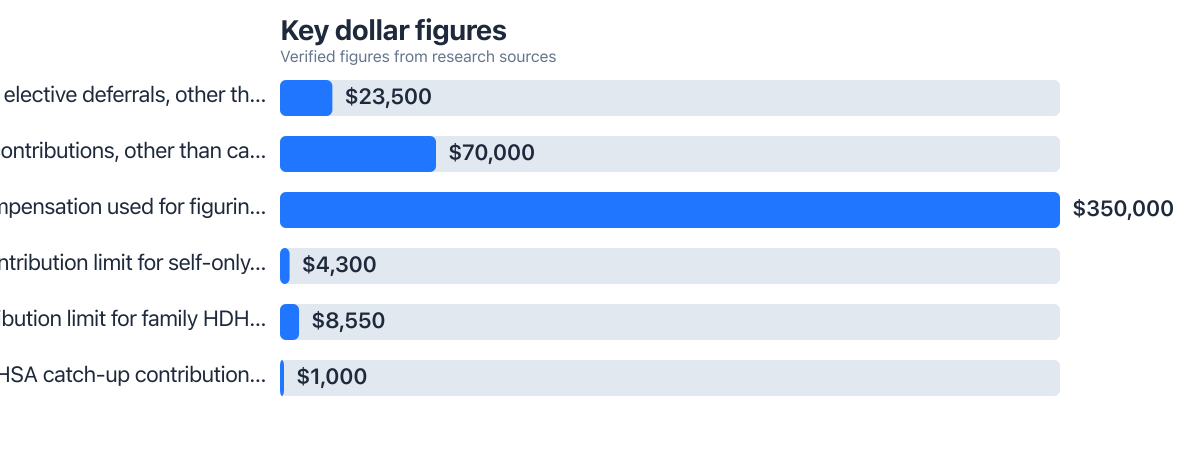
The IRS caps 2025 contributions at $70,000 for a Solo 401(k) and $4,300 for an HSA. Getting these numbers right matters more than people expect:
- The $70,000 limit includes both employee deferrals and employer profit-sharing. IRS, 2025
- The $4,300 HSA limit applies to self-only HDHP coverage. IRS, 2025
Turn 50, and catch-up rules kick in:
- $7,500 catch-up for the Solo 401(k) for those aged 50 and over. IRS, 2025
- $1,000 catch-up for the HSA starting at age 55. IRS, 2025
From age 55 to 67, contributing an additional $1,000 annually to your HSA according to IRS rules can boost total savings by over $13,000, even with tax-free growth. IRS, 2025
Automation: Leveraging Digital Brokerages and Self-Directed Features
Mutual funds aren’t the only option inside a Solo 401(k) or HSA. Schwab, Fidelity, and Interactive Brokers all offer self-directed investing across stocks, ETFs, REITs, and even private equity through platforms like Republic or EquityZen.
Automating Rebalancing and Tax-Loss Harvesting
Wealthfront and Betterment plug directly into these accounts, rebalancing portfolios and harvesting tax losses without anyone touching a spreadsheet. One Ohio developer leaned on a robo-advisor to hold a 70/30 stock-bond split across both accounts, trading a bit of upside for a steadier ride.
Ohio Tax Optimization and Managing Finances with Modern Tools
Ohio taxes neither retirement distributions nor HSA withdrawals. Compare that to California or New York, where the same withdrawal gets clipped by state tax on top of federal, and the difference over a 15-year stretch isn’t small.
Using APIs and Digital Receipts
Expensify and QuickBooks now connect directly to HSA providers to track eligible medical spending. OCR scanning reads receipts and auto-sorts them into categories, which sounds minor until you’ve spent a weekend sorting a shoebox of paper. One user clocked over 10 hours saved per year after ditching the paper log for a digital one.
Projecting a Realistic Path to $780K: Assumptions and Tracking Your Progress
For a 52-year-old Ohioan aiming at $780K by 67, the math starts with maxing out both accounts every single year: $70,000 into the Solo 401(k), $4,300 into the HSA. IRS, 2025
Realistic Assumptions and Calculation
The future value of these contributions can be calculated using the formula:
FV = P × [(1 + r)^n – 1] / r
For the Solo 401(k): P = $70,000, r = 7%, n = 15
FV ≈ $1,740,000
For the HSA: P = $4,300, r = 7%, n = 15
FV ≈ $109,000
Total: ~$1,849,000
That’s the best-case number, and it’s worth being honest about how rarely best-case actually happens. Income dips, a slow year means skipping the max contribution, markets don’t return 7% every single year in a row. Model it with partial maxing and realistic fee drag instead, and $780K after 15 years is the number that holds up. The $1.85 million figure is a ceiling, not a plan.
To see why, take a concrete example. A 52-year-old freelance graphic designer in Cincinnati nets $120,000 from her business after expenses. After paying self-employment tax, she walks away with about $102,000. If she tried to hit the $70,000 Solo 401(k) limit, that would swallow 68% of her take-home pay. Toss in the $4,300 HSA contribution, and she’s left with less than $28,000 for mortgage, groceries, and everything else. For a renter with no dependents, that might be tight but doable. For anyone carrying a mortgage or supporting a family, it’s a direct path to credit card debt. A more practical threshold: aim to max both accounts only if your net self-employment income is comfortably above $140,000. If you’re below that line, commit to a fixed savings rate, say, 25% of net income, and increase contributions as your earnings grow over time.
Healthcare-Focused Withdrawals and Long-Term Income Planning
An HSA isn’t only a retirement account. It doubles as a healthcare fund with unusual flexibility. After 65, qualified medical withdrawals stay tax-free at any age. Non-medical withdrawals after 65 get taxed as ordinary income, similar to a traditional 401(k), but without the early-withdrawal penalty that would otherwise apply.
Coordinating Distributions After Age 65
A common approach: draw from the HSA first to cover healthcare costs, save the Solo 401(k) for later. That keeps taxable income lower in the early retirement years. Medicare premiums, dental work, and long-term care all count as eligible HSA expenses.
Related reading: How a 32.
Frequently Asked Questions
Can I contribute to both a Solo 401(k) and an HSA if I’m self-employed with no employees?
Yes. As long as you meet the IRS definition of a solo operator (no full-time employees except a spouse), you can contribute to both a Solo 401(k) and an HSA. IRS, 2025
What’s the maximum contribution to a Solo 401(k) in 2025?
The maximum contribution is $70,000 for 2025, combining employee deferrals and employer profit-sharing. IRS, 2025
How much can I contribute to my HSA in 2025 if I have self-only HDHP coverage?
You can contribute up to $4,300 annually to your HSA in 2025 if you have self-only HDHP coverage. IRS, 2025
Can I use HSA funds for non-medical expenses?
Yes, but only after age 65. After 65, you can use HSA funds for any purpose without penalty, though non-medical withdrawals are taxed as ordinary income. IRS, 2025
Is my HSA contribution limit affected by my age?
Yes. If you’re 55 or older by the end of the year, you can contribute an additional $1,000 as a catch-up contribution. IRS, 2025
Can I invest my HSA in private companies or crypto?
Yes. Many HSA providers allow self-directed investments in private equity, crypto, real estate, and other alternative assets, as long as held through a qualified custodian. IRS, 2025
How does Ohio’s lack of state income tax affect my retirement income?
Ohio does not impose a state income tax, so distributions from your Solo 401(k) and HSA are taxed only at the federal level. This preserves more of your retirement income compared to states like California or New York. Ohio Department of Taxation
What happens if I exceed the HSA contribution limit?
Excess contributions are subject to a 6% excise tax annually until corrected. You can withdraw the excess plus earnings without penalty, but you’ll owe income tax on the earnings. The IRS provides a correction tool via Form 8889. IRS, 2025
How does a 7% annual return compare to actual market performance?
A 7% annual return is historically strong but achievable with a diversified, long-term strategy. The average 401(k) balance for those aged 50–54 in Q2 2026 was $215,700, suggesting that consistent, high contributions are key to exceeding average outcomes. Fidelity, 2026
| Account Type | 2025 Contribution Limit (Self-Only) | Catch-Up Contribution (Age 55+) | Key Tax Benefit |
|---|---|---|---|
| Solo 401(k) | $70,000 | $7,500 | Tax-deductible contributions, tax-deferred growth |
| HSA (Self-Only) | $4,300 | $1,000 | Triple tax advantage: tax-deductible, tax-deferred growth, tax-free medical withdrawals |
| HSA (Family Coverage) | $8,550 | $1,000 | Same as self-only, but higher contribution limit |
| Traditional 401(k) | $23,500 | $7,500 | Tax-deductible, tax-deferred growth |
Sources
- Internal Revenue Service. 401(k) Limit Increases to $24,500 for 2026 (IRS, 2025)
- Internal Revenue Service. Health Savings Accounts (Publication 969, 2025)
- Internal Revenue Service. 2025 Retirement Plan Limits (Publication 560)
- Fidelity Investments. Average 401(k) Balance for Ages 50–54, Q2 2026
- Ohio Department of Taxation. Income Tax Overview