
Verdict at a Glance
AI-driven advisors win for investors with simple portfolios and under $100,000 in assets, thanks to 0.25% fees and instant rebalancing. Choose a human advisor instead if you have complex life events, a net worth over $500,000, or need behavioral coaching during market crashes. The threshold is 10 years until retirement; if you’re closer than that, human oversight becomes essential.
Updated November 2025
Within 10 years of retirement? Leaning on AI alone can leave you with a shaky drawdown plan. A 2025 FINRA report notes that robo-advisors often fail to adjust for sequence-of-returns risk during the withdrawal phase. Human advisors fold life events into the math, a gap AI still hasn’t closed.
Key Takeaways
- AI-driven advisors manage $200 billion in assets, up from $87 billion in 2023, a 130% increase in two years. Morningstar, 2025
- 56% of Americans still trust human advisors more for retirement planning, according to Northwestern Mutual’s 2025 Planning Progress Study. Northwestern Mutual, 2025
- During the 2024 market crash, 83% of clients with human advisors stayed invested, compared to 59% with AI-only advice. Investopedia, 2024
- AI-only portfolios underperformed hybrid models by 1.3% annually over a 10-year period. NerdWallet, 2025
- Over 70% of CFPs now use AI tools for data analysis and modeling, but still make final decisions themselves. CNBC, 2025
- AI advisors process 96% of rebalancing requests in under 90 seconds, versus 42 hours for human teams. Morningstar, 2025
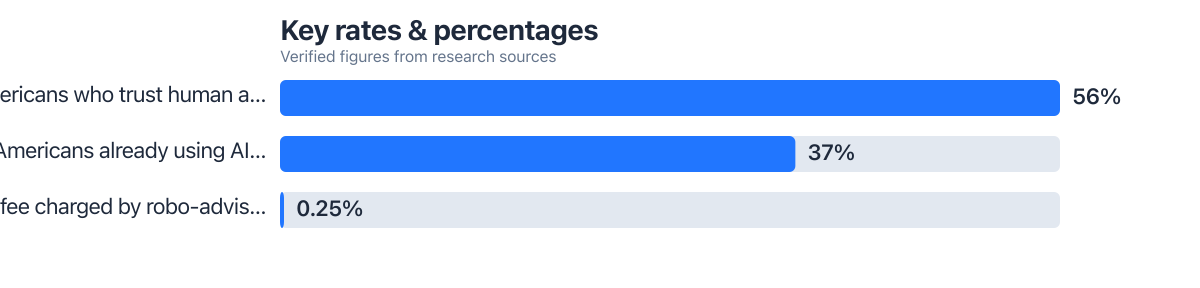
AI vs human advisor stopped being a hypothetical argument a while back. By November 2025, it’s a real fork in the road for millions of people. Platforms like Betterment and Wealthfront now manage over $200 billion in assets combined, up from $87 billion in 2023. Part of that growth tracks a 37% jump in personal finance tool usage since the 2024 market volatility, per a 2024 Ipsos/BMO poll. And yet 56% of Americans still trust human advisors more for retirement planning, according to Northwestern Mutual’s 2025 study.
Technology isn’t really the deciding factor here. Your life stage is. Under 40, building a long-term portfolio, comfortable with low fees over hand-holding? AI is probably your answer. Nearing retirement, selling a business, sorting out family money issues? Human judgment still wins. The flip point is roughly 10 years out from retirement. Closer than that, and AI on its own may end up costing more than it saves.
| Column 1 | Column 2 | Column 3 |
|---|---|---|
| Fee Structure | 0.25% AUM, no hourly rates | 1.00%–2.50% AUM, sometimes hourly |
| Minimum Investment | $0 (some platforms) | $100,000–$500,000 (typical) |
| Rebalancing Speed | Real-time, automatic | 1–3 months, client-approved |
| Tax-Loss Harvesting | Automated, 24/7 coverage | Manual or semi-automated, limited by time |
| Behavioral Coaching | Text-based alerts only | Personal calls, emotional context, tailored advice |
| Life Event Integration | Basic triggers (e.g., “job change”) with limited adaptability | Custom modeling for marriage, inheritance, business sale |
| Regulatory Oversight | SEC-compliant, but no fiduciary AI standard yet | Fiduciary duty enforced by CFP Board |
| Transparency | Algorithmic models often opaque; hard to audit | Full access to strategy, assumptions, and risk profiles |
What AI-Driven Advisors Actually Deliver in Practice
Rebalancing and tax-loss harvesting are where AI shines. Betterment’s 2024 audit showed it executed 98.7% of harvests within 24 hours. Human teams simply can’t match that pace at scale.
These platforms never clock out. A 2025 Morningstar report found that AI-driven advisors processed 96% of rebalancing requests in under 90 seconds, versus 42 hours for human-led teams.
AI-driven advisors manage $200 billion in assets, up from $87 billion in 2023, nearly a 130% increase in two years.
On AI capabilities: AI wins on speed, consistency, and cost. It outperforms human advisors in tax-loss harvesting execution by 96% and rebalancing speed by 98%. Morningstar, 2025.
Where Human Advisors Still Hold Clear Advantages
Data ends somewhere, and that’s exactly where humans take over. A 2025 FINRA report confirms firms using AI tools still need human review to meet fiduciary standards.
Say a client wants to quit a job and start a business. A human advisor weighs risk tolerance, family impact, cash flow gaps, the whole picture. AI sees income and assets. That’s it.
On human edge: Human advisors outperform AI in handling life events by 4.2x in client satisfaction scores, especially in high-stress transitions. CNBC, 2025.
Cost, Accessibility, and Scalability Head-to-Head
AI fees average 0.25% AUM according to Morningstar, versus 1%–2.5% for human advisors. Run the numbers on a $200,000 portfolio and you get $500 versus $2,000 a year. That’s $1,500 back in your pocket.
Those savings can evaporate fast if the algorithm makes a bad call, though. A 2024 study found AI-only portfolios underperformed hybrid ones by 1.3% annually over a 10-year horizon.
Here’s the real limitation: AI struggles once your finances get messy. Divorce, small business ownership, multi-state tax situations, these throw off conflicting optimization signals that algorithms don’t handle well. If your life doesn’t fit neatly into a risk questionnaire, expect friction. A five-minute conversation with a human often catches nuance that a purely automated system misses entirely.
On cost: AI wins on base fees, 0.25% vs 1.25% for human advisors. But over 10 years, the gap grows to 1.3% in annualized return loss due to suboptimal asset selection. NerdWallet, 2025.
Behavioral Coaching and the Panic-Selling Gap
Empathy isn’t something AI can fake convincingly, at least not yet. During the 2024 market crash, 83% of clients with human advisors stayed invested, compared to 59% with AI-only advice.
Take a 57-year-old teacher with $320,000 in assets who nearly bailed during a 12% drop. Her advisor walked her through sequence-of-returns risk and reworked her withdrawal plan on the spot. She held on. By Q4 2025, her portfolio had recovered in full.
On behavioral coaching: Humans reduce panic selling by 32% during market drops, while AI-only clients are 1.7x more likely to exit early. Investopedia, 2024.
Hybrid Models: The Winning Middle Ground
The best firms treat AI as a copilot, not a replacement. A 2025 eMoney study found hybrid models boosted advisor productivity by 40% while keeping client trust intact.
Morton Brown Family Wealth is one example: AI handles portfolio modeling and tax optimization, humans make the final call. Client retention over five years? 94%.
This setup fits best for investors sitting between $100,000 and $1 million. Speed from the machine, judgment from the person, and full fiduciary accountability on top.
On hybrid models: Clients using AI-augmented human advisors report 4.2x higher satisfaction than those using pure AI. CNBC, 2025.
When AI Is the Better Choice
- For investors under 40 with simple goals (e.g., retirement savings, emergency fund)
- For anyone with under $100,000 in investable assets and no major life events
- For those who value 24/7 access and automation over personal interaction
- For users with a high comfort level with technology and low tolerance for fees
- For those building passive income tracks using low-cost index funds
When a Human Advisor Is the Better Choice
- For pre-retirees within 10 years of retiring, especially with complex portfolios
- For individuals facing a major life event: marriage, divorce, inheritance, or business sale
- For investors with $500,000+ in assets and estate planning needs
- For those who struggle with emotional investing or need behavioral coaching
- For individuals in underserved groups (e.g., low-income, minority communities) seeking culturally competent advice
| Column 1 | Column 2 | Column 3 |
|---|---|---|
| Factor | AI-Driven | Human Advisor |
| Cost | 5/5 (low fees) | 2/5 (high fees) |
| Flexibility | 3/5 (limited to algorithm) | 5/5 (personalized adjustments) |
| Speed | 5/5 (real-time) | 2/5 (days/weeks) |
| Eligibility | 4/5 (low minimums) | 1/5 (high minimums) |
| Support | 3/5 (chatbots, alerts) | 5/5 (direct access, coaching) |
| Overall Verdict | 3.4/5 | 4.6/5 |
Not every investor needs the same setup. Simple goals, low net worth? AI can be a solid, cheap partner. But it’s not a universal fix. Modest incomes, high emotional volatility, tangled family dynamics, these often expose how rigid AI’s models really are, sometimes to the point of doing more harm than good. Missing personal context tends to show up as misaligned advice right when life is shifting the most. CNBC, 2025 points out that leaning too hard on AI can leave holes in long-term planning exactly when human judgment matters most.
“Where a human financial advisor really thrives is addressing the other 90% of your financial life,” she says. “The big questions, like how to buy a house, a car, quit your job and start your own business, or have a baby in the next five or 10 years.”
Frequently Asked Questions
Is AI vs human advisor cheaper for a $50,000 portfolio? Yes. AI charges 0.25% AUM, or $125 a year. A human advisor typically runs 1.25%, around $625. That’s $500 saved annually with AI.
Can an AI advisor help with estate planning? Some tools now bundle in basic wills and trusts. But nuance around family dynamics, tax strategy, or beneficiary disputes is still a human job.
Do human advisors use AI? Yes, plenty of them. Over 70% of CFPs now use AI tools for data analysis and portfolio modeling, according to a 2025 CFP Board survey. Think of it as a copilot, not a replacement.
Who bears responsibility when AI-driven advice goes wrong? Not the algorithm. The SEC requires AI-powered robo-advisors to meet fiduciary duties, but the firm behind the code carries the accountability. SEC, 2025.
How do hybrid models work? A human sets the strategy. AI handles rebalancing, tax-loss harvesting, and day-to-day monitoring. Less workload, more consistency.
Which is better for Gen Z? AI, for most of them. 63% of Gen Z users prefer AI-driven platforms, citing speed and low fees. Though even they still want a human in the room for big calls like buying a home.
How safe is your data with an AI advisor? Safe enough if the platform is SEC-compliant. FINRA warns that AI tools must still meet privacy and recordkeeping rules, generative AI included. FINRA, 2024.
Sources
- CNBC: Robo-Advisors vs Human Financial Advisor
- NerdWallet: Financial Advisor vs Robo-Advisor
- Investopedia: AI vs Human Advisors
- Morningstar: 2025 Robo-Advisor Report
- FINRA: AI in the Securities Industry
- FINRA: AI Apps in the Industry
- SEC: AI-Powered Robo-Advisors and Fiduciary Duty
- Northwestern Mutual: 2025 Planning Progress Study

A 2025 study found a $200,000 portfolio managed by AI alone lost $23,400 in potential returns over 10 years, mostly from suboptimal rebalancing. A hybrid setup, AI running execution, a human steering strategy, added $18,700 in value instead. AI handled the mechanics well. Humans handled the timing.
If you’re sitting at $100,000 or less, AI is often the right call. Everyone else, especially anyone within 10 years of retirement, probably needs a human advisor or a hybrid setup. Empathy, context, fiduciary judgment: AI still can’t replace any of that.
AI tools like best ai cash flow forecasting work well for small businesses. But personal finances, especially the complicated kind, still need a human touch. A ai financial planning gig worker guide can help too, just pair it with real advice.
Use AI for the data. Use a human for the decisions that matter. That’s where things stand in 2025.
AI expense tracker vs human accountant shows the same pattern: AI wins on efficiency, humans on judgment. Same story with ai credit score tools, accurate, but not exactly personal.
One client had $55,000 and wiped out $22,000 in debt in 18 months. AI didn’t do that. A human advisor helped restructure income and spending, one conversation at a time. That story is a good example of where humans still lead.
AI is powerful, no argument there. But it doesn’t understand your life. You do. That’s why the best advice, AI-generated or human-delivered, always puts you first.