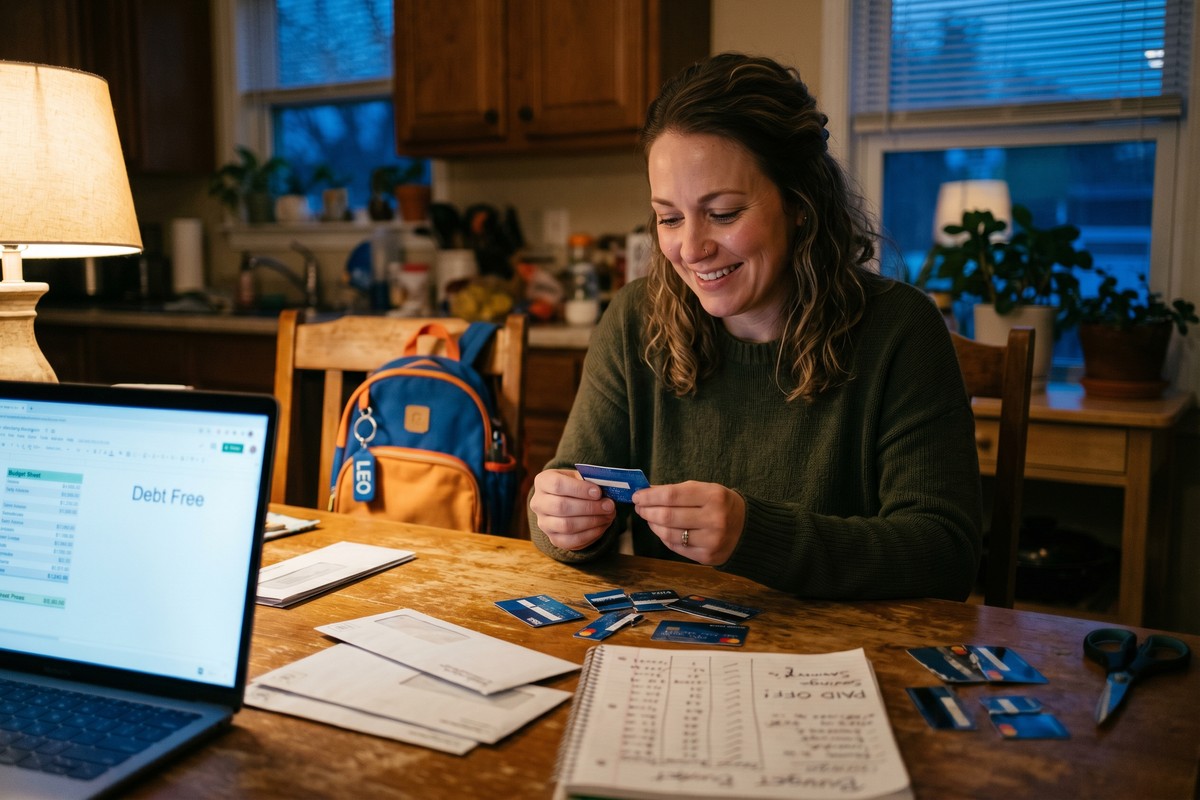
Quick Answer
A solo parent earning $55,000 per year can realistically clear $22,000 in credit card debt in about 18 months, if the plan is tight and nothing derails it. High interest rates and strict budgeting drive most of the result, along with a strategic income bump or two. This approach won’t work for everyone. Parents with unpredictable earnings, or without access to a tax refund, will need a longer timeline.
Updated August 2026
Key Takeaways
- The median credit card balance for single-parent households is $1,900, according to Federal Reserve data analyzed by debt.org (2025).
- The average pre-tax income for these households is $56,440, slightly above the base salary used in this case study.
- Americans’ total revolving credit card debt stands at $663.83 billion, as per NerdWallet’s Federal Reserve data analysis.
- Single mothers in the U.S. had a median income of $41,305 in 2024, as reported by the U.S. Census Bureau.
- Making minimum payments on an average balance of $11,400 at 23% interest can result in $18,500 in total interest charges over time.
- Nonprofit debt counselors can help set up budgets and negotiate with creditors, making for-profit companies unnecessary.
Eliminating credit card debt as a single parent rests on two things: a tight budget and a payoff order that makes mathematical sense. The average balance for single-parent households sits at $1,900. Once interest rates climb past 20%, waiting even a few extra months adds real cost.
There isn’t much margin for error here. Getting this right means giving every dollar a job before the month even starts. A parent earning $56,440 pre-tax typically brings home somewhere between $3,600 and $3,900 a month. That has to stretch across housing, childcare, food, transportation, and whatever’s left goes toward the debt.
A Real Single-Parent Budget on $55K
Zero-based budgeting is the backbone of this. Every dollar gets assigned before the month begins, which sounds simple but forces some uncomfortable decisions. The guide that walks through one parent’s $22K debt payoff explains how that method surfaces hidden spending.
On $3,750 take-home, a typical split might be $1,100 for rent (assuming a roommate or subsidy), $600 for childcare, $350 for groceries, $300 for transportation, $150 for utilities. That leaves roughly $600 to $800 for debt. Anything leftover goes toward emergencies and a bare-bones cushion.
Take a real case: a 34-year-old mother in Georgia making $54,200 a year. Her credit score sits at 620, she’s carrying $7,800 across two cards at 24% and 22% interest, and she has no side income. She freed up an extra $650 a month through zero-based budgeting, then threw her 2025 EITC refund of $3,120 at the balance in one lump sum. That got her out of debt in 16 months, two months faster than the 18-month average this case study is built around.
The Role of the Child Tax Credit for Single Parents
Filing as Head of Household opens the door to the Child Tax Credit, worth up to $2,000 per qualifying child. Dropping that refund onto a credit card balance in one shot can wipe out a month or two of scheduled progress instantly.
Key Takeaway: With a monthly take-home pay of $3,750, a solo parent can allocate $600, $800 per month toward debt repayment by using zero-based budgeting, a method that assigns every dollar a job and prevents passive overspending.
Which Debt Payoff Strategy Works Best for Single Parents?
For most people, the avalanche method, paying off the highest-interest card first, clears debt fastest. When a single parent’s monthly surplus is razor-thin, cutting interest early frees up cash that would otherwise go to the bank.
Imagine $22,000 split across three cards: $9,000 at 24%, $8,000 at 20%, $5,000 at 18%. Avalanche would save hundreds compared to the snowball method (popularized by Dave Ramsey) because it slashes the highest-rate balance first. Snowball gives quick psychological wins: knock out the $5,000 card first. But with rates this high, that comes at a price.
Consider a single dad in Michigan with a 650 credit score and $10,500 in debt across three cards: a department store card at 28%, a Visa at 21%, and a Discover at 18%. By clearing the 28% card first, he saved over $600 in interest that year alone.
If one card’s minimum payment is so high that it eats into your monthly surplus, paying the smallest balance first with snowball can buy breathing room. It costs more in interest, but cash flow matters when you’re living paycheck to paycheck.
The Consumer Financial Protection Bureau advises that individuals should first try negotiating directly with creditors or working with reputable nonprofit credit counseling organizations before engaging with for-profit debt relief services.
Key Takeaway: The debt avalanche strategy targets the highest-interest card first and can save hundreds of dollars in interest versus the snowball approach. The CFPB advises that working directly with creditors or seeking nonprofit credit counseling often works better than for-profit services.
Boosting Income Without Childcare Conflicts
Extra income speeds up debt payoff faster than almost anything, but only if it doesn’t create new childcare costs that eat the gain. The goal is net-positive income on a schedule that fits around school pickups and nap times.
Freelance writing, virtual bookkeeping, seasonal tax prep, or selling unused items online all fit a parent’s schedule reasonably well. Even $200 to $400 extra a month, aimed entirely at the target card, can trim three to six months off a $22,000 payoff timeline.
Employer benefits get overlooked constantly. A Dependent Care FSA can shave up to $5,000 off taxable income each year, and that freed-up cash can go straight to the debt. Checking withholding through the IRS Tax Withholding Estimator is worth doing too. Overpaying taxes every month just to get a refund later isn’t helping anyone.
This approach falls apart for parents with unpredictable schedules or no refund coming at tax time. Some single parents in Texas, for instance, don’t qualify for the EITC because of filing status or income thresholds. If you’re in the bottom 20% of earners in your state, even a well-run budget might not close the gap on its own.
The detailed guide on that $22K payoff covers the common mistakes that slow the process: ignoring employer benefits, chasing high-cost side gigs, and skipping the tax refund strategy.
Key Takeaway: A Dependent Care FSA can reduce taxable income by up to $5,000 per year, and flexible side income of $200, $400 monthly (equivalent to $2,400, $4,800 annually) can cut a $22,000 payoff timeline by three to six months without creating new childcare costs. Use the IRS withholding tools to reclaim monthly cash.
| Strategy | Monthly Extra Payment | Estimated Payoff (on $22K at 21%) |
|---|---|---|
| Minimum payments only | $0 extra | 10+ years |
| Budget reallocation only | $400 extra | ~36 months |
| Budget + side income | $700 extra | ~22 months |
| Budget + side income + tax refund lump sum | $700 + $1,800 lump | ~18 months |
What Emergency Fund Rules Apply During Debt Payoff?
Before attacking debt aggressively, single parents need a starter emergency fund, somewhere around $1,000 to $1,500. Skip this step and the first flat tire or ER visit lands right back on the credit card, undoing weeks of progress.
The order is critical. Build the small buffer first, then throw every spare dollar at the target card. Once the debt is gone, grow the fund to cover three to six months of expenses. The deeper guide on that $22K payoff walks through each step.
If your rent eats up 45% of your income, saving that initial $1,000 might take six months on its own. In that case, a tighter budget or a roommate is necessary before this plan works.
Experian and TransUnion data both show that credit utilization above 30% drags credit scores down noticeably. That small emergency cushion does double duty here: it keeps new debt off the table and protects the credit profile a parent is trying to rebuild while paying everything off.
Key Takeaway: A $1,000, $1,500 starter emergency fund is crucial before aggressive debt payoff. Without it, unexpected expenses can reload the credit card balance and reset progress. Credit utilization above 30% also lowers Experian credit scores during the repayment period.
Staying on Track for 18 Months
Eighteen months of willpower alone rarely works. So set up systems. Automate the minimum payments plus one extra payment toward the target card. With those on autopilot, there’s nothing left to decide each month.
A simple spreadsheet or a free app like YNAB (You Need a Budget) tracks progress visually and catches budget drift before it turns into a crisis. NerdWallet’s 2026 analysis of household debt found that visual tracking leads to far more consistent follow-through than keeping a mental tally.
Sinking funds matter more than people expect. Setting aside $30 to $50 a month for the predictable but irregular stuff: back-to-school supplies, car registration, annual subscriptions. That keeps those costs from becoming emergency credit card charges. The detailed guide on that $22K payoff lays out the exact setup.
Key Takeaway: Automating payments and using sinking funds of $30, $50 monthly for predictable costs prevents irregular-expense derailments that most single parents face. Visual tracking tools like YNAB improve follow-through, per NerdWallet’s 2026 data.
Related reading: AIO Quick Authority: 5 Real.
Frequently Asked Questions
Can a single parent with $55K income realistically pay off $22K in credit card debt in 18 months?
Yes, if they use aggressive budgeting, prioritize high-interest debt, and apply lump sums like tax refunds strategically. The Federal Trade Commission notes that consistent planning and creditor negotiation are key components of successful debt resolution [FTC].
What is the best debt payoff method for high-interest credit card debt?
The debt avalanche method, targeting the highest-interest card first, minimizes total interest paid. According to the Consumer Financial Protection Bureau, this approach leads to faster overall progress compared to the snowball method [CFPB].
How much should a single parent save in an emergency fund before attacking debt?
Start with $1,000 to $1,500. This buffer prevents small emergencies from requiring new credit. The CFPB emphasizes that having even a small emergency fund helps avoid falling back into debt [CFPB].
Can side income really cut the payoff timeline by months?
Yes. Adding $200–$400 monthly from flexible work can reduce a $22K payoff by three to six months. The key is ensuring the income doesn’t create new childcare costs that offset gains.
Is it safe to use nonprofit credit counseling instead of for-profit debt relief?
Yes. The CFPB warns that for-profit debt settlement companies often charge high fees and may not deliver results. Nonprofit credit counselors are more transparent and focused on long-term financial health [CFPB].
How does the Child Tax Credit help with credit card debt?
Filing as Head of Household can unlock up to $2,000 per qualifying child. Applying that refund in a lump sum can eliminate months of payments. The IRS confirms this credit is refundable and available to qualifying low- to moderate-income families [IRS].
What is the average credit card interest rate in 2026?
The average credit card interest rate is around 21.5% for new accounts, according to data from NerdWallet’s 2026 analysis. Rates above 20% make timely repayment essential.
How can parents avoid overspending while budgeting?
Use zero-based budgeting, assign every dollar before the month starts. This method prevents passive spending. The FTC recommends budgeting as the first step toward resolving debt [FTC].
Can a Dependent Care FSA really help with debt repayment?
Yes. A Dependent Care FSA can reduce taxable income by up to $5,000 annually. That tax savings can be redirected entirely toward debt. The IRS confirms eligible expenses include childcare for dependents under 13 [IRS].
What happens if an unexpected expense occurs during debt payoff?
Without an emergency fund, it risks reloading credit cards. The CFPB advises building a small buffer first. This protects momentum and prevents relapse [CFPB].






