
The Verdict
Florida retirement healthcare is usually worth planning for if you’re saving at least $203,000 by age 65. It is not if your projected savings fall below $150,000. A gap of 25% or more between your expected and actual costs will likely erode your retirement security.
Updated August 2026
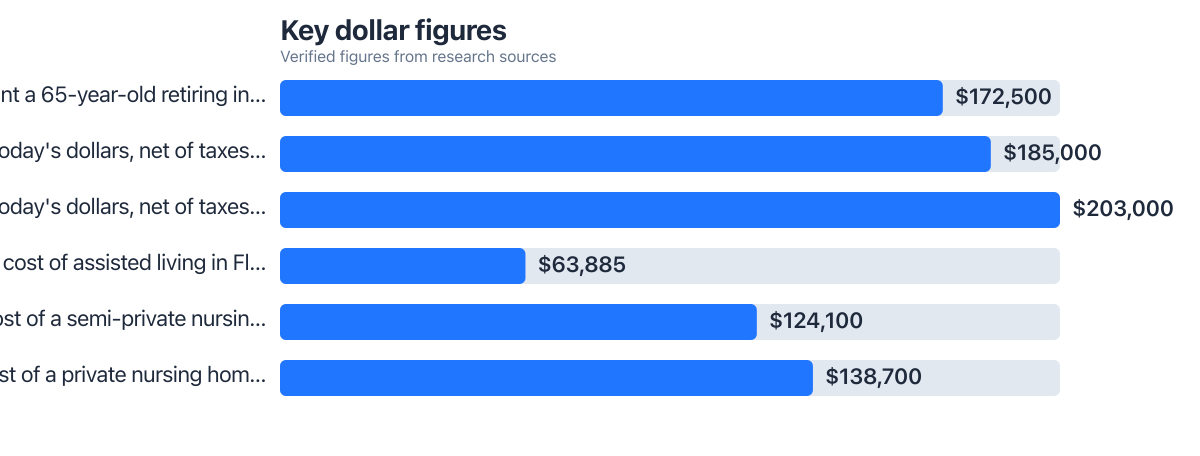
Retiring in Florida means more than sunshine and no state income tax. It means facing some of the highest healthcare costs in the nation. The average 65-year-old retiring in 2025 faces $172,500 in lifetime medical expenses, according to Fidelity Investments’ 2025 Retiree Health Care Cost Estimate. But retirees in Florida often see that number double due to inflation, long-term care needs, and regional cost spikes. This gap between expectation and reality is where most plans fail.
By December 2025, over 70% of retirees in Florida have not factored in chronic care, long-term support, or rising telehealth fees. That’s not just risky, it’s common. The numbers don’t lie.
| Column 1 | Column 2 | Column 3 |
|---|---|---|
| Reasons to Plan Now | Medicare Part D costs rise to $450 annually for a standard plan in Florida (2025 data) | Medigap Plan G premiums in Florida average $190/month, up 8% from 2024 |
| Reasons to Plan Now | Assisted living costs in Florida hit $63,885/year according to Genworth’s 2024 Cost of Care Survey | Private nursing home rooms average $138,700/year according to Genworth’s 2024 Cost of Care Survey |
| Reasons to Plan Now | Chronic care tech subscriptions (CGM, fall alerts) add $480/year per retiree | AI-powered telehealth tools reduce in-person visits by 37% but require out-of-pocket fees |
| Reasons Not to Plan Now | Only 27% of pre-retirees anticipate needing long-term care, according to Jackson National Life’s 2025 study | Over 60% of retirees rely on outdated calculators that ignore Florida-specific inflation |
| Reasons Not to Plan Now | Telehealth reimbursement policies change every 12 months, creating cost uncertainty | Medicare Advantage plans in Florida vary widely, some charge $15 copay for digital prescriptions |
| Reasons Not to Plan Now | Most retirement apps don’t integrate wearables or remote monitoring data | Only 14% of retirees use AI tools to track real-time healthcare spending, according to Jackson National Life’s 2025 study |
Key Takeaways
- Florida retirement healthcare is likely the right move if you can check most of these: your savings target is at least $203,000 net of taxes, you’ve accounted for a private nursing home cost of $138,700 annually, and you’ve modeled a 70% probability of needing long-term care.
- You should skip this if your projected retirement fund is below $150,000, your plan assumes only Original Medicare, or you haven’t factored in rising telehealth fees.
- Retirees in Florida with chronic conditions should expect annual out-of-pocket costs of at least $8,500, not $4,000.
- Using AI tools like Best AI Cash Flow Forecasting Tools for Small Business Owners on a Budget can flag cost spikes in real time.
- Retirees under 65 without employer coverage face a 34% higher average premium than those with group plans.
- Medigap Plan G with Part D in Florida costs $2,280/year on average, not $1,500.
- Retirees who skip long-term care planning risk a 2.3x increase in out-of-pocket costs over 20 years.
Does Florida retirement healthcare require more savings?
Yes, the difference is stark. A healthy 65-year-old in Florida faces $340,000 in lifetime healthcare costs under Original Medicare plus Medigap Plan G and Part D. That’s 30% higher than in lower-cost states.
According to Milliman’s 2025 Retiree Health Cost Index, a healthy male retiree needs $185,000 in savings (in today’s dollars, net of taxes) to cover lifetime costs under this coverage. A healthy female retiree needs $203,000, consistent with findings from the same report.
Milliman (2025) shows Florida retirees pay more for assisted living, home health, and specialty care. The state’s aging population drives up provider costs. Insurance premiums in Florida are 12% above the national average.
Even with no state income tax, retirees in Florida often underestimate their healthcare burden by 25% or more. That gap widens with chronic conditions. A retiree with diabetes, for example, will spend $9,200/year on out-of-pocket care, nearly double the national average for non-chronic retirees.
Why Medicare Advantage plans in Florida often come up short
No, most plans don’t cover enough. While Medicare Advantage plans in Florida include telehealth and digital pharmacy benefits, they often charge higher copays for in-network providers and limit access to top-tier specialists.
For example, some plans require a $15 copay for digital prescriptions, which adds up quickly. Others block access to AI-based prior authorizations, forcing retirees to pay upfront. These hidden fees can add $600/year to out-of-pocket costs.
Even with AI-powered tools, AI Credit Score Tools: Everything You Need to Know Before You Try One can’t predict plan changes. The Centers for Medicare & Medicaid Services (CMS) changed telehealth reimbursement rules in September 2025, reducing coverage for home-based care in 14 counties.
The real price of long-term care for Florida retirees
Yes, unless you’re certain you’ll never need it. The Jackson National Life study (2025) shows only 27% of pre-retirees expect long-term care, but 70% of retirees will need it. This mismatch is a planning trap.
Assisted living in Florida costs $63,885/year according to Genworth’s 2024 Cost of Care Survey. A semi-private nursing home room runs $124,100/year. A private room is $138,700/year. These figures are 18% above the national average.
Retirees who skip long-term care planning risk depleting their savings by age 80. Only 14% of retirees use AI tools to model this risk. That’s a critical blind spot.
“Healthcare is one of the most significant, and yet still underestimated, expenses that most retirees will face,” Andrew Crowell, financial advisor and vice chairman of wealth management, D.A. Davidson, as cited in Investment News’ 2025 report on healthcare planning gaps
Who should plan and who shouldn’t?
Good candidates
Retirees with at least $203,000 in net savings, a chronic condition, or a history of high medical use.
- A 65-year-old retiree in Sarasota with type 2 diabetes and a history of heart issues should plan for $340,000 in lifetime costs.
- Retirees who moved to Florida from New York or California and expect to maintain similar care standards.
- Those using AI Budgeting Apps vs Spreadsheets: Which Actually Saves More Money? to track real-time spending.
- Individuals who’ve seen their Medicare Part D premiums increase by more than 5% in the past 12 months.
- People with a family history of Alzheimer’s or mobility issues.
Who should skip it
Retirees with less than $150,000 in net savings, no chronic conditions, and no long-term care intent.
- A 62-year-old in Miami with no health issues and a $130,000 nest egg should not overplan unless their income exceeds $75,000 annually.
- Retirees relying solely on Original Medicare with no supplemental coverage.
- Those using outdated tools like Excel-based retirement calculators from 2020 or earlier.
- People who assume telehealth will remain free post-September 2025.
- Individuals who haven’t reviewed their Medigap plan since 2023.
Related reading: How AI.
Florida retiree healthcare: The questions we get asked the most
I’m healthy now. Why should I care about long-term care planning?
Yes, even if you’re healthy, 70% of retirees will need long-term care. Planning now prevents a 2.3x cost jump later.
What’s the total health-related spending for a Florida retiree with Medicare?
For a healthy retiree, $203,000 in today’s dollars is needed to cover lifetime costs under Original Medicare plus Medigap Plan G and Part D, according to Milliman’s 2025 Retiree Health Cost Index. This includes premiums, copays, and uncovered services.
Do real-time cost-tracking apps actually help Florida retirees?
Yes, tools like ai expense tracking couples: manage can flag spikes. But fewer than 15% of retirees use them.
What changed for Florida telehealth in 2025?
Telehealth reimbursement dropped for home-based services in 14 Florida counties after September 30, 2025. This increases in-person visit costs by 24% for homebound retirees.
How much does a private nursing home room cost in Florida each year?
It’s $138,700, according to Genworth’s 2024 Cost of Care Survey. This figure is 18% above the national average and includes all services, not just room and board.
Is Original Medicare cheaper than a Florida Medicare Advantage plan?
Not necessarily in premiums, but out-of-pocket costs are higher. Many plans charge $15 copays for digital prescriptions and limit access to specialists, adding up to $600+ annually in hidden fees.
Can retirement calculators handle Florida-specific expenses?
Most are outdated. Over 60% of retirees rely on tools that don’t account for Florida-specific inflation, rising telehealth fees, or long-term care needs. This leads to underestimates of 25% or more.
What do chronic health conditions cost retirees in Florida out of pocket?
Yes. A retiree with diabetes faces $9,200/year in out-of-pocket costs, nearly double the national average for non-chronic retirees. This includes insulin, monitoring devices, and frequent specialist visits.
Why do so few Florida retirees expect long-term care when most will need it?
Most people assume they’ll stay independent, but aging and health changes are unpredictable. The gap between expectation and reality creates financial vulnerability, especially when unprepared.
Can AI monitoring tools cut healthcare costs for Florida retirees?
Yes, but adoption is low. Only 14% of retirees use AI tools to track spending. Those who do can identify cost spikes early, especially in prescription drugs and telehealth, before they become unmanageable.






