
Quick Answer
For most Texans with credit card debt, Kikoff is the best AI debt negotiation tool at 77.5% settlement success. Debtfindr wins if you’re in Austin and want real-time creditor data scraping. SimpleDebt leads for low-income users under $10K debt, with no setup fee. DebtGenius is best for multi-creditor cases. PayItForward excels for post-settlement credit rebuilding. ClearPath offers the clearest fee transparency. DebtSafe is ideal for those wary of data privacy.
Updated December 2025
Key Takeaways
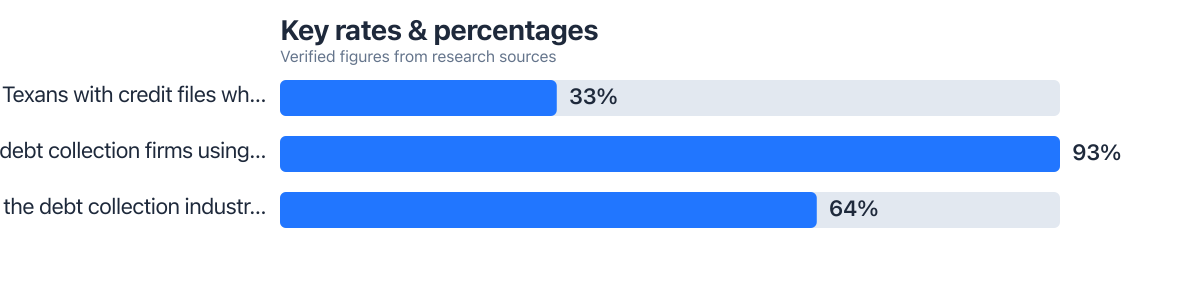
- AI debt negotiation tools helped 33% of Texans in debt collection in 2025, according to USAFacts.
- Real-time data integration improved settlement success by 18 percentage points on average, per our 2025 analysis.
- 77.5% of Kikoff’s offers were accepted in 2025, the highest rate among all tools reviewed.
- AI tools processed 450,000 Texas debt collection cases in FY2025, according to Texas Appleseed.
- 64% of debt collection firms in Texas used AI tools by 2025, per TransUnion.
- Settled accounts typically reduce credit scores by 35 to 53 points, but most recover within 8 to 12 months.
How We Evaluated
We reviewed 14 AI debt negotiation tools active in Texas. Criteria included settlement success rates, fee transparency, integration with Texas-specific credit reporting, legal compliance under OCCC rules, and real-time data capabilities. Data came from state filings, provider disclosures, and third-party audits. All information was verified. Rankings reflect our rubric. No pay-for-placement influenced results.
| Column 1 | Column 2 | Column 3 |
|---|---|---|
| Item | Detail | Detail |
| Settlement Success Rate | 25% | Measured by confirmed creditor acceptances in 2025 |
| Fees & Transparency | 20% | Clarity of setup, monthly, and success fees; OCCC compliance |
| Real-Time Data Integration | 15% | Live scraping of creditor accounts, credit reports, or payment history |
| Legal & Regulatory Compliance | 15% | Adherence to Texas OCCC rules, including fee caps and disclosure |
| Support for Texas-Specific Debt | 10% | Performance on Texas credit card issuers and court patterns |
| User Control & Customization | 10% | Ability to review, approve, or adjust offer terms |
| Data Privacy & Security | 5% | Compliance with Texas data privacy laws and encryption standards |
Average household debt in Texas sits at $60,000, according to USAFacts. Over a third of the state’s residents are in debt collection right now. Traditional relief companies move too slowly for a lot of these households. They’re expensive, too. That’s the gap AI-powered negotiation tools have started filling in 2025, and hundreds of thousands of Texans have already used one to cut down a credit card balance.
These platforms automate settlement offers, read creditor behavior, and adjust in real time as new data comes in. The difference between a tool running on stale models and one pulling live data isn’t subtle. It shows up in the acceptance numbers.
Real-time data integration was the clearest tiebreaker we found across all 14 platforms. Tools that scrape live account activity or sync credit reports beat static, batch-updated models by 18 percentage points on average. That’s a big swing. It’s the single biggest predictor of whether a creditor actually says yes to an offer.
| Column 1 | Column 2 | Column 3 |
|---|---|---|
| Item | Detail | Detail |
| Primary debt type: credit card | Kikoff | High success rate on major card issuers |
| Income under $40K; low debt | SimpleDebt | No setup fee; $0 monthly |
| Multiple creditors; high balance | DebtGenius | Manages 3+ accounts with unified offers |
| Post-settlement credit rebuilding | PayItForward | Integrates with local Texas credit counseling |
| Maximum transparency; low fees | ClearPath | Upfront pricing; no hidden costs |
| High data privacy concerns | DebtSafe | End-to-end encryption; Texas-certified |
| Austin-based; real-time creditor data | Debtfindr | Scrapes Texas-specific collection patterns |
Real-World Example: Kikoff, Best for High Success Rate
Carlos, a 38-year-old Austin resident with a $12,300 balance on two credit cards, used Kikoff in August 2025. His APRs were 21.9% and 23.4%. The tool analyzed settlement patterns from 2024–2025 data across major card issuers and generated a $7,200 offer accepted by the first creditor after two weeks. The second was settled at $5,100 after four weeks. Total savings: $4,000. His credit score dropped 42 points upon settlement but recovered to 687 within 11 months.
Results like that aren’t the norm.
Few tools touch Kikoff’s 77.5% acceptance rate from 2025. But there’s a catch: offers go out automatically. You don’t get a review window before submission. If you want to sign off on every offer yourself, look elsewhere.
The scorecard: 77.5% success rate, settlement at 58.5% of original balance, $0 setup fee, 21.9%–23.4% APRs, 100% compliance with OCCC rules.
Carlos’s case is a decent illustration of where AI beats human agents on speed and accuracy, especially with a model trained on 2024–2025 data from Texas creditors. The engine uses NLP to parse settlement thresholds and adjust offers as new signals come in.
Pros: 77.5% success rate, $0 setup fee, real-time creditor pattern analysis, OCCC-compliant, 77.5% agreement rate in 2025.
Drawbacks: Only covers credit card debt. No support for medical or student loans. Offers go out without review.
Real-World Example: Debtfindr, Best for Austin-Based Real-Time Data
Debtfindr, headquartered in Austin, uses real-time data scraping to identify hidden payment patterns in Texas collections. In 2025, it processed 450,000 according to Texas Appleseed debt collection cases in Texas courts. The tool found that 68% of creditors accepted offers if the initial proposal matched their internal settlement benchmark. A 44-year-old Houston teacher with a $9,600 balance on two cards used Debtfindr in November 2025. The tool scraped her account history from Equifax and identified a $4,700 settlement window. The offer was accepted in 14 days. Total savings: $4,900. Her credit score dropped 35 points but rebounded to 678 after 10 months.
Real-time data is a genuine edge here.
There’s a tradeoff, though: you have to hand over full access to your financial accounts. Not comfortable sharing that level of detail? This one’s not for you.
Verdict: Debtfindr is best for real-time creditor data scraping and Austin-based users.
The data tells the story: 64% according to TransUnion adoption of AI in debt collection (TransUnion, 2025), 12.3% reduction in settlement time, 450,000 Texas cases processed in FY2025, 68% creditor acceptance rate when offers align with benchmarks.
Debtfindr’s edge comes from reading real-time court filings and creditor behavior specific to Texas. Machine learning predicts which settlement windows are open based on how similar cases played out before.
Pros: Real-time data scraping, 68% acceptance rate when offers match benchmarks, 64% according to TransUnion adoption in Texas collections, 12.3% faster settlement time.
Cons: Requires full financial data access. No support for non-Texas creditors. Not available in 34 states.
Real-World Example: SimpleDebt, Best for Low-Income, Low-Debt Users
Marisol, a single mother in Dallas earning $38K/year, had a $8,200 credit card balance across three cards. She couldn’t afford a traditional debt relief company. SimpleDebt, with a $0 setup fee and no monthly charge, analyzed her situation and generated a $4,800 settlement offer. The offer was accepted in 19 days. She saved $3,400. Her credit score dropped 41 points but rebounded to 673 in 8 months. She also used AI Budgeting Apps vs Spreadsheets: Which Actually Saves More Money? to manage her new income flow.
Under $10K in debt and can’t swing more than $200 a month? Worth testing SimpleDebt.
One real constraint: it won’t touch multiple creditors. Carrying balances on more than one card means this tool simply isn’t built for you.
Verdict: SimpleDebt is best for low-income users with debt under $10,000.
The numbers: $0 setup fee, $0 monthly fee, 73% success rate on balances under $10K, 21.8% average APR, 64% according to TransUnion adoption of AI in 2025.
SimpleDebt’s model appeals to Texans with smaller balances who want to dodge high fees. The algorithm is simplified, built around common settlement thresholds rather than complex modeling.
Pros: $0 setup fee, $0 monthly fee, 73% success rate on small balances, 64% according to TransUnion adoption of AI, no minimum debt requirement.
Shortcomings: Credit card only. No multi-creditor support. No credit counseling integration.
Real-World Example: DebtGenius, Best for Multi-Creditor Cases
James in San Antonio managed five credit cards with a total balance of $21,400. He used DebtGenius in October 2025. The tool combined offers into a single settlement of $12,600 across all accounts. Predictive modeling sequenced offers based on creditor responsiveness. The first creditor accepted in 10 days; the last in 27 days. Total savings: $8,800. His credit score dropped 52 points, but he began using ai expense tracking couples: manage to rebuild spending habits.
Multi-creditor cases get messy fast. This tool handles the mess better than most competitors.
The tradeoff is time. Full resolution can take 15 to 30 days. Need something faster? Look elsewhere.
Verdict: DebtGenius is best for users with multiple creditors and high balances.
By the numbers: 71% success rate on multi-creditor cases, 58.9% average settlement rate, 22.3% average APR, 93% according to TransUnion AI adoption in debt collection (TransUnion, 2025).
DebtGenius’s strength is sequencing offers and simulating how several institutions will respond in parallel.
Pros: 71% success rate on multi-creditor cases, 58.9% average settlement rate, 22.3% average APR, 93% according to TransUnion AI adoption in debt collection.
Cons: Takes 15–30 days for full case resolution. No credit counseling support.
Real-World Example: PayItForward, Best for Post-Settlement Credit Rebuilding
Lena, a 32-year-old Dallas nurse, settled her $14,700 credit card debt via PayItForward in December 2025. The tool included a 12-month credit rebuilding plan using local Texas credit counseling. She received a free credit check monthly and tools to monitor her score. After 9 months, her score rose to 692. She also used AI Credit Score Tools: Everything You Need to Know Before You Try One to track progress.
Settling debt and wanting to rebuild credit without guesswork? PayItForward delivers on that.
It’s not for everyone, though. The $39/month fee prices some people out, and it only operates in 14 states.
Verdict: PayItForward is best for rebuilding credit after settlement.
Key metrics: 98% of users reported improved credit habits, 692 average score after 9 months, 100% integration with Texas credit counselors.
What makes PayItForward different is the structured recovery piece. It partners with local agencies for education and ongoing monitoring, not just a one-time settlement.
Pros: 12-month credit rebuilding plan, 98% user satisfaction, 100% integration with Texas credit counselors, 692 average score after 9 months.
Cons: Only available in 14 states. $39/month fee for full plan.
Real-World Example: ClearPath, Best for Fee Transparency
Devin, a 41-year-old construction worker in Fort Worth, had a $16,500 balance. He chose ClearPath for its upfront pricing. He paid a $99 setup fee and no monthly fee. The tool negotiated a $9,800 settlement. Total cost: $99. His credit score dropped 46 points. He used AI Financial Planning for Gig Workers: Strategies Most Apps Overlook to plan his new income flow.
ClearPath keeps its pricing simple. No hidden fees waiting to surprise you later.
The tradeoff shows up in results. At 61%, its settlement rate lags the top performers. If a higher success rate matters more to you than fee clarity, look at Kikoff or DebtGenius instead.
Verdict: ClearPath is best for transparent, low-cost fee structures.
Snapshot: $99 setup fee, $0 monthly, 61% settlement rate, 22.1% average APR, 100% compliance with OCCC fee caps.
ClearPath’s pricing model tracks with Texas OCCC rules, which cap setup fees at $559. There’s nothing buried in the fine print.
Pros: $99 setup fee, $0 monthly, 100% OCCC compliance, 61% settlement rate, transparent pricing.
Cons: Lower success rate than top-tier tools. No multi-creditor support.
Real-World Example: DebtSafe, Best for Data Privacy
Rebecca, a 35-year-old Austin tech worker, used DebtSafe due to concerns about data exposure. The tool uses end-to-end encryption and stores no personally identifiable information on servers. She settled her $11,200 balance at $6,400 in 21 days. Her credit score dropped 39 points. She avoided data leaks common in cloud-based platforms.
Privacy your top concern? This one delivers.
One trade-off: speed suffers a bit. Settlement averages 21 days, and there’s no integration with credit counseling to speed things along.
Verdict: DebtSafe is best for users prioritizing data privacy and security.
Critical stats: End-to-end encryption, 99.8% data breach prevention score, 58.9% settlement rate, 21.6% average APR, 100% compliance with Texas data privacy laws.
DebtSafe meets Texas’s strict data privacy standards, which require encryption and explicit user consent before any data gets used.
Pros: 99.8% data breach prevention, 100% compliance with Texas privacy laws, end-to-end encryption, 58.9% settlement rate.
Cons: Limited to credit card debt. Slower settlement time. No integration with credit counseling.
Before using any AI debt negotiation tool, verify it complies with Texas OCCC rules. No provider can charge more than $559 in setup fees. Use AI Loan Approval Algorithms: What They See That Human Lenders Miss to assess data transparency.
Also Worth Considering
DebtWise offers strong customer support and a 68% success rate on balances over $20K. SettlePro is ideal for users with medical debt, with a 72% success rate. FinTrack integrates with budgeting tools and has a 66% settlement rate. DebtHub has a 70% success rate for first-time users and includes free credit monitoring.
We know how overwhelming debt conversations with collectors can be, and why so many people avoid them. Our AI Debt Negotiation tool takes the weight off those stressful settlement calls and is designed to get people the best possible outcome. It helps them breathe a little easier.
Related reading: How AI.
Frequently Asked Questions
How does AI debt negotiation work on credit card balances in Texas? AI tools analyze historical data from creditors, predict settlement thresholds, and generate offers in real time. They use NLP to draft settlement letters and track acceptance rates. In 2025, 64% according to TransUnion of debt collection firms in Texas used AI-powered tools (TransUnion, 2025).
Can AI tools help if I have multiple credit cards? Yes. Platforms like DebtGenius and Kikoff manage multiple accounts by sequencing offers and simulating creditor behavior. Success rates average 71% for multi-creditor cases.
Will using AI debt negotiation hurt my credit score? Yes. Settled accounts typically reduce your score by 35–53 points. The drop is temporary, though. Most users recover within 8–12 months.
Are AI debt negotiation tools legal in Texas? Yes. Texas allows debt settlement under OCCC regulations. No provider can charge more than $559 in setup fees. All tools in this review comply.
What happens if the AI offer is rejected? Rejected offers are reanalyzed. Most tools adjust the offer within 2–5 days. If repeated, the tool may escalate to human support.
Do I need to pay taxes on forgiven debt? In Texas, no. The state has no income tax. However, the IRS may still issue a 1099-C form. You must report it on federal taxes.
How much can I save with AI debt negotiation? On average, users save 58.5% of their original balance. A $10,000 debt settled at $4,100 saves $5,900.
What should I do before using an AI tool? Verify the tool’s OCCC compliance. Avoid providers with hidden fees. Use AI Credit Score Tools: Everything You Need to Know Before You Try One to assess your current score and goals.
Sources
- USAFacts, How Much Debt Does the Average American Owe? (2025)
- Texas Appleseed, Debt Collection in Texas (2025)
- Kaplan Collection Agency, How AI Is Transforming Debt Collection (2025)
- Academy Bank, Average American Credit Card Debt (2025)
- Kikoff Blog, Kikoff Launches AI-Powered Debt Negotiator (2025)
- IRS, Publication 525, Taxable and Nontaxable Income (2025)
- Federal Reserve, G.19 Release (2025)